
Smart Manufacturing
November 19, 2026
Operational Excellence in Real Estate: When Building Automation Meets IT
# Smart Buildings
# Automation
# IOT
# Building Management Systems
# Ecosystem & Collaboration
# Digital Transformation
How access management can connect people, spaces and building systems

Industry Signals
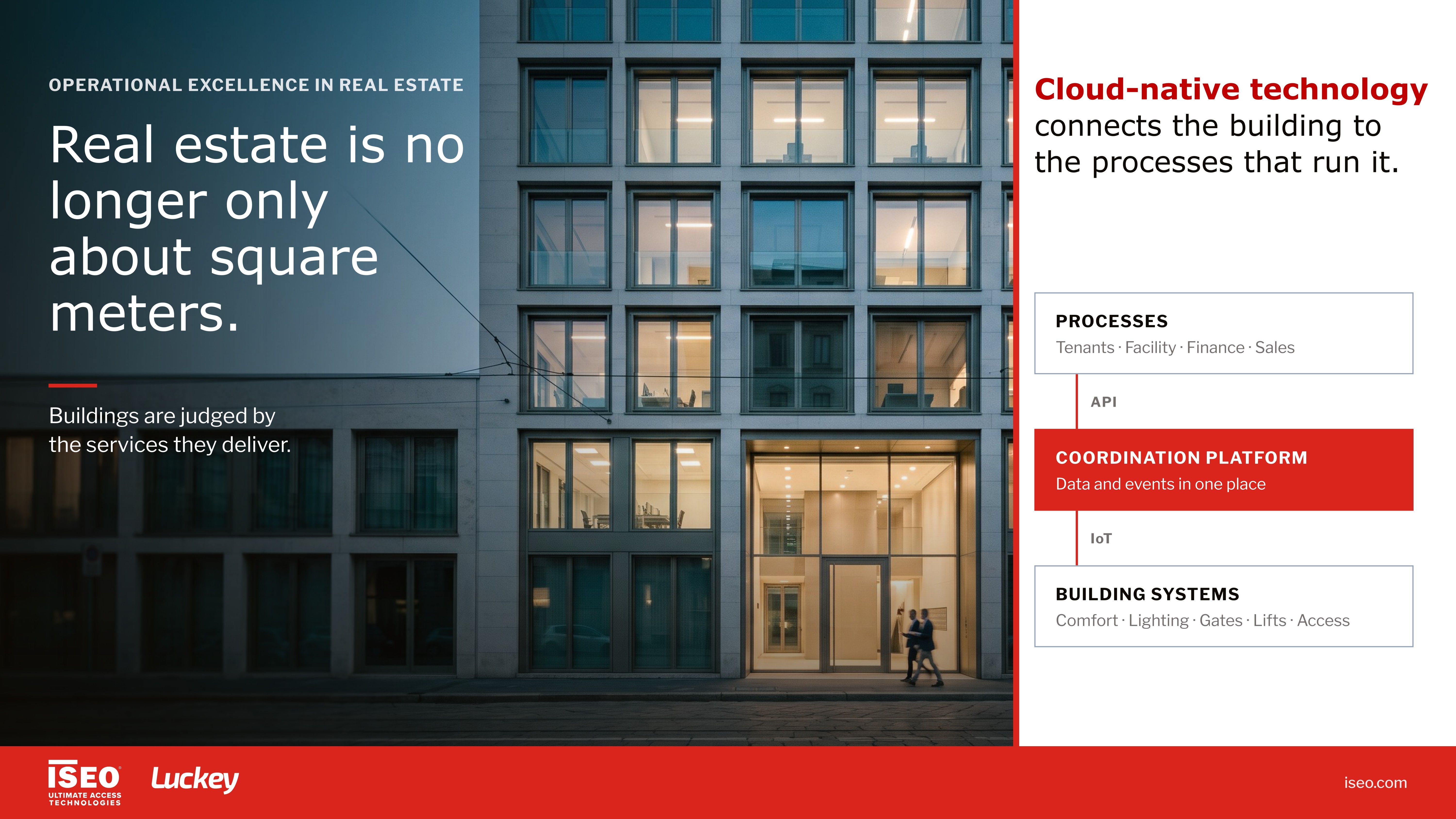
Real estate is no longer only about square meters. In the Real Estate as a Service (ReaaS) model, landlords become service providers. Buildings are judged by what they deliver: easy access, comfortable spaces, safe and efficient operations. How far a building is automated decides which business models a landlord can offer and which ways of managing space a tenant can adopt. Buildings consume more than 40% of the world's energy, so the way they are run also matters well beyond the balance sheet.
In this edition of Industry Signals, we look at:
- Siemens' data on where building value is won or lost, and how ready organizations are to digitalize;
- ISEO's case for Operational Excellence as the operating model behind ReaaS;
- how access management can connect building automation to IT ecosystems such as Microsoft's, illustrated by a meeting room that sets itself up; and
- occupancy data as both an operational and a safety asset.
Siemens on Where Building Value Is Won or Lost
Sources: Siemens – Smart building infrastructure | Siemens Infrastructure Transition Monitor 2025: Inside smarter buildings | Published: October 2025
Siemens' research points to the operating phase as the place where buildings create, or waste, value. Its 2025 Infrastructure Transition Monitor, based on a survey of 1,400 executives, shows organizations are ready to invest, but are less advanced at connecting the systems and partners involved.
Key ideas:
- Office space is often underused: "nearly half may be unused, yet 80% of a building's total lifecycle costs occur during operation."
- 55% of respondents plan to increase investment in smart building technologies, and 56% see strong potential for digitalization to cut costs.
- Only 42% of organizations consider themselves mature or advanced in building collaborative digital ecosystems with partners and suppliers.
- Only 50% say they have the data they need to make decarbonization decisions.
ISEO on Moving from Landlord to Service Provider
ISEO, a partner on the Siemens Xcelerator Marketplace, describes ReaaS as a move away from managing physical assets towards managing flows, data and services. The aim is to earn revenue from the productivity and well-being a space gives its users, not to bill for square meters. ISEO calls this shift Operational Excellence, and argues that it relies on building automation and IoT technologies.
Key ideas:
- Value has to flow along the whole chain, from the capital investor to the tenant and the end user.
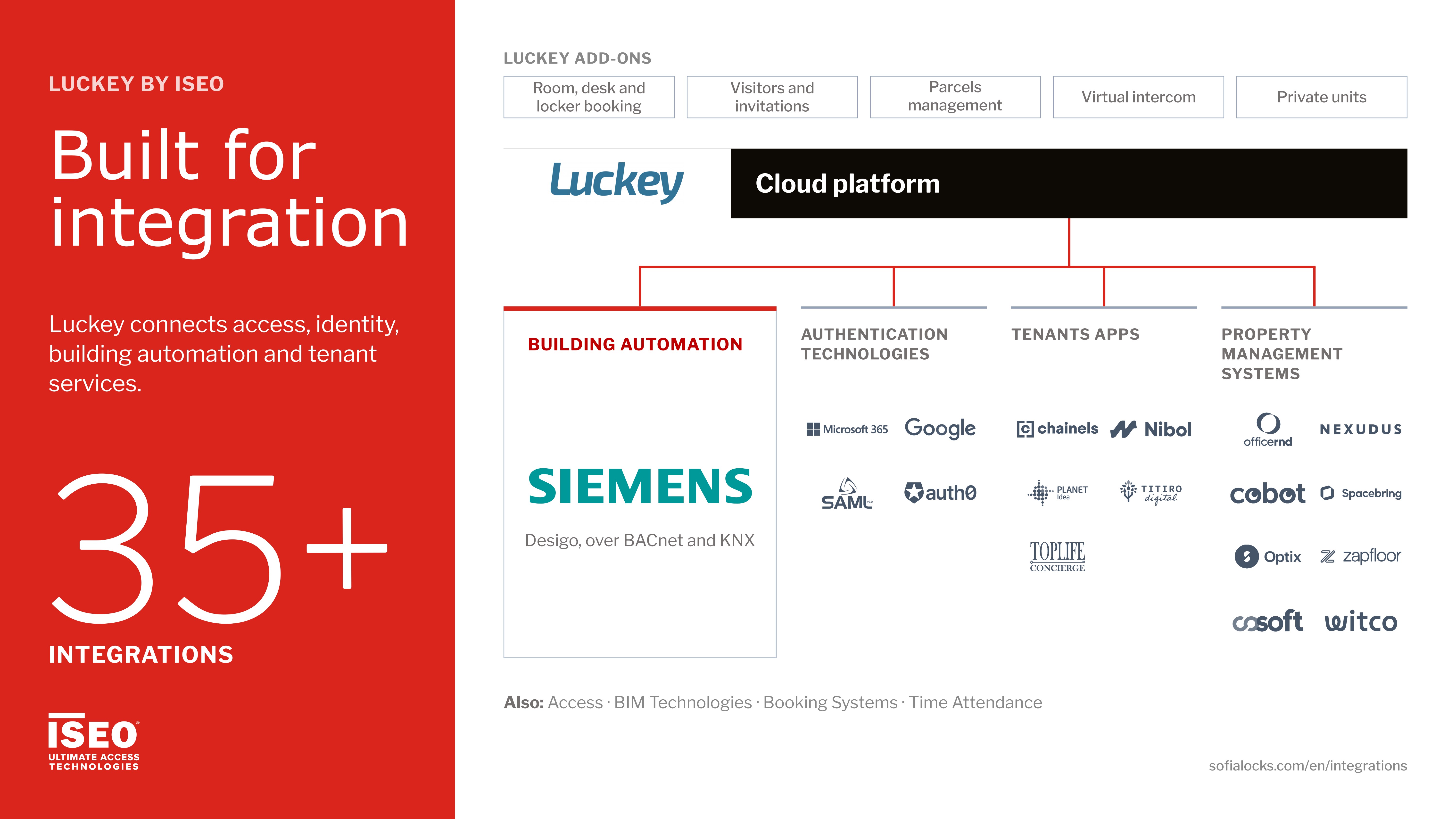
- That needs a technology base built for integration, where identity management (single sign-on), the Building Management System and tenant apps work together.
- Access control is no longer only about security. The digital lock becomes a "service enabler": an entry point for self-service, on-demand deliveries and tenants managing their own spaces.
- In ISEO's words, efficiency is not a cost but a driver of profit.
ISEO on Connecting Building Automation to the IT World
Traditional building automation is very good at running a building by its own rules: schedules, setpoints, sensors, alarms. Platforms such as Siemens Desigo, working over BACnet and KNX, keep HVAC, lighting and blinds under control across whole portfolios. ISEO's point is that one link is still missing: the IT world where occupants spend their day.
The company illustrates it with an everyday scenario. An employee signs in to the Luckey app with their Microsoft account and books a meeting room, either in the app or directly from Outlook or Teams. Luckey issues a virtual key for that room and that time slot. When the employee opens the door, the HVAC switches on.
Key ideas:
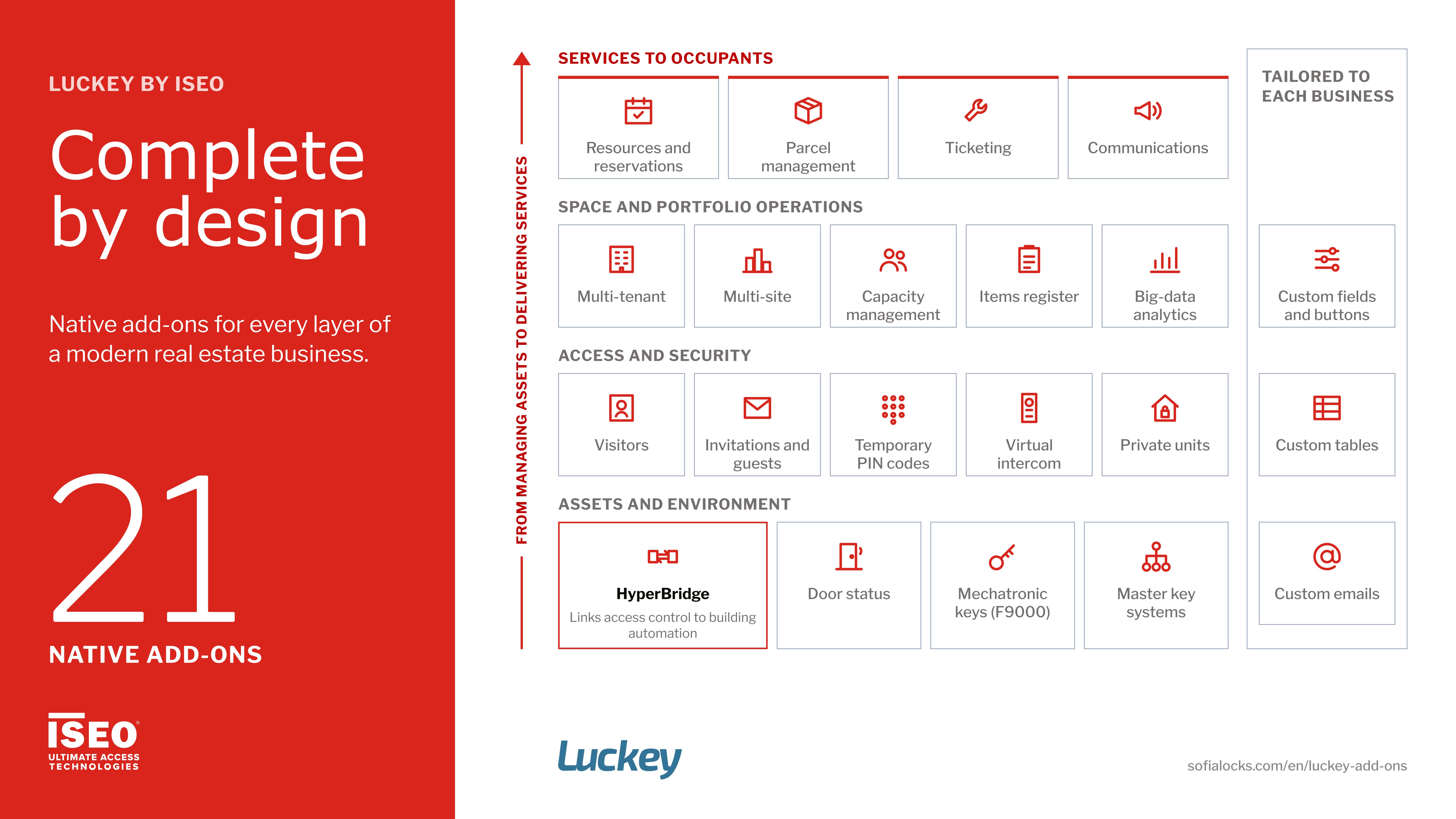
- HyperBridge, ISEO's fully programmable module, connects the Luckey access management platform to building automation systems such as Desigo. It works with standard building protocols on one side and IT interfaces, including MQTT, on the other.
- Access management already knows who people are, through Microsoft Entra ID single sign-on, and which spaces they're entering. That makes it a natural bridge between what happens in IT and what the building does. In the scenario above, the HVAC is effectively responding to a Microsoft identity.
- What happens next depends on how the building is set up: warming up or cooling down the room before the meeting starts, switching to economy mode once it's empty, releasing rooms when nobody shows up, or responding differently when the cleaning staff come in.
- The result: comfort when it's needed, energy saved when it isn't, and fewer manual tasks for facility managers.
ISEO on Occupancy as an Operational and Safety Asset
Every time someone badges in or out, the building learns something about who is there. Combined with occupancy detection and linked to the same Microsoft identities, Luckey shows facility teams how many people are in the building, area by area, at any moment.
Key ideas:
- Day to day, occupancy data helps answer the underused-space question Siemens raises, and lets cleaning and maintenance follow actual use rather than fixed schedules.
- In an emergency such as a fire alarm, it answers the first question every responder asks: how many people are still inside, and where?
- This matches what respondents to Siemens' 2025 survey expect from more autonomous buildings: 32% expect more effective responses to anomalies or emergencies, and 30% expect stronger physical security and access control.
- As our Future of Fire Safety edition noted, knowing sooner is worth more than reacting harder. Occupancy data adds a human dimension to that early warning, alongside the detection systems already in place.
Looking Ahead
ReaaS changes the question owners ask. It's no longer only "how do we run this building?" but "what services can this building deliver, and to whom?" Siemens' data suggests the will to invest is there. What lags is the ability to connect systems and partners, with only 42% of organizations reporting maturity in digital ecosystems. Building automation brings control. IT brings identity, calendars and collaboration. Access management sits between them, because it's where a person meets a space.
The harder part is governance. When a tenant's corporate identity can switch on a landlord's HVAC, questions of data ownership, privacy and cybersecurity cross organizational lines. That's why 34% of Siemens' respondents see higher cybersecurity risk in autonomous buildings, and 59% believe occupants will still demand human oversight of building operations. Operational Excellence will scale only as fast as these connections can be trusted.
That's a wrap for this edition of Industry Signals. Have a report, use case, or event you'd like to see featured in an upcoming issue? Send a note via PM. We're always looking to spotlight what's shaping the future of industry, and recommendations from the Xcelerator Community are especially valuable. Your insights and experiences continually shape Industry Signals.
Comments (0)
Popular

Dive in
Related
Blog
Distributed Manufacturing's Real Test: Balancing Proximity, Demand, and Inventory
By Industry Signals • Sep 22nd, 2026 • Views 183
Blog
Agent-to-Agent Commerce: When Buyer Bots Meet Seller Bots
By Industry Signals • Sep 8th, 2026 • Views 269
Blog
Distributed Manufacturing's Real Test: Balancing Proximity, Demand, and Inventory
By Industry Signals • Sep 22nd, 2026 • Views 183
Blog
Agent-to-Agent Commerce: When Buyer Bots Meet Seller Bots
By Industry Signals • Sep 8th, 2026 • Views 269