
Smart Manufacturing
September 22, 2026
Distributed Manufacturing's Real Test: Balancing Proximity, Demand, and Inventory

# Microfactory
# AI
# Digital Manufacturing
# Digital Twin & Simulation
# Factory of the Future
# Innovation
Microfactories put production near demand; whether they scale depends on consistency across sites.

Industry Signals
it.
In this edition of Industry Signals, we look at:
- Stratasys’ view of the six areas where additive manufacturing holds a clear advantage;
- Deloitte's look at distributed manufacturing as an emerging response to defense industrial capacity constraints; and
- A Siemens conversation with Haddy CEO Jay Rogers on what a working microfactory looks like today.
Stratasys on What Only Additive Can Do
Speaking at Additive Manufacturing Strategies 2026, Stratasys’ CEO Yoav Zeif argued that despite a multi-year slump in industrial hardware sales, additive manufacturing is following a familiar capital-goods adoption curve. He used that framing to lay out where he thinks the technology's real advantage lies.
Key ideas:
- Zeif named six areas where he believes additive manufacturing offers a distinctive advantage over conventional processes: digital inventory, low-volume/high-mix production, complex geometries such as lightweighting and internal channels, supply chain security, sustainability, and time reduction.
- He linked that advantage directly to decentralized production, describing a model where authenticated digital files let parts be printed close to the point of use instead of shipped from centralized stock, with OEMs retaining control and revenue through the authentication layer.
- Defense and aerospace are adopting fastest, which Zeif attributed to budget growth and urgency around supply chain resilience.
Deloitte on Distributed Manufacturing as a Defense Industrial Strategy
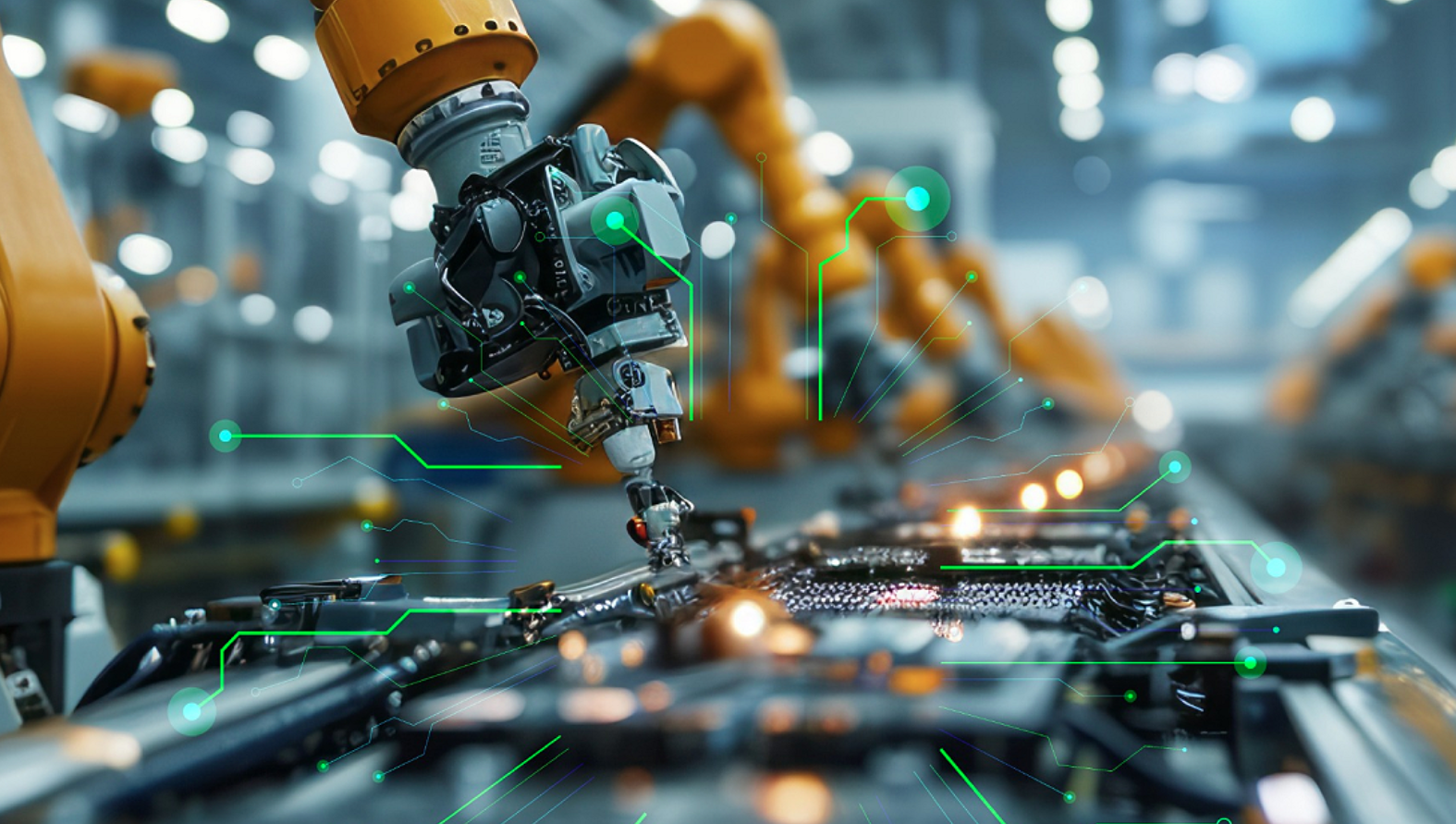
Deloitte's report on US defense manufacturing arrives at distributed production from a different starting point: a national security capacity problem rather than additive manufacturing's promise. It's a useful check on whether the idea holds up outside the industry that has been promoting it.
Key ideas:
- Deloitte identifies distributed manufacturing, alongside automation, as one of two emerging responses that let defense contractors expand production capacity and diversify risk.
- Deloitte sees two models in recent moves: spreading production across multiple company-operated sites, and shifting work to networks of partner producers.
- In some cases, these networks run on the same digital and automation capabilities that connect equipment across sites. Deloitte cites one prime that links roughly 17,000 pieces of equipment across 40 factories on a single platform.
- There is a tradeoff: distributed production shifts a prime contractor's role from managing a single factory to orchestrating a broader network, introducing new challenges in quality assurance, configuration control, cybersecurity, and schedule coordination.
Siemens on Haddy's Microfactory Model
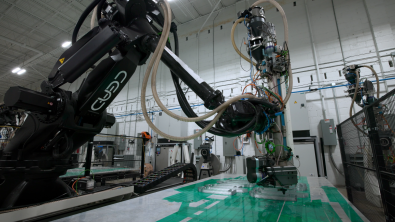
For a concrete picture of what this looks like in practice, Siemens' Pioneers podcast sat down with Jay Rogers, CEO and co-founder of Haddy, a digital manufacturing company built around large-scale 3D printing microfactories.
Key ideas:
- Rogers describes distributed robotic manufacturing as an alternative to centralized factory systems, with production sited close to the communities that need the product.
- He frames the shift as a move from an economy of scale to what he calls an economy of scope: the same microfactory, driven by digital design files, can produce a wide range of different products instead of being optimized around long runs of one thing.
- Haddy's approach combines robotics, AI-assisted production monitoring, recyclable materials, and digital twin technology, and the company has expanded beyond its original furniture focus into sectors including defense and disaster recovery.
- Rogers ties the model to a broader reindustrialization argument, framing localized, digitally driven production as a way to bring manufacturing capability back to US cities.
Looking Ahead
Microfactories change a familiar question. Instead of how much to make and where to store it, manufacturers are now asking where capacity should sit and how fast a digital file can become a physical part. A design that can be built at the nearest capable site works like inventory, minus the shelf life, and it lets one facility handle many different products instead of being built around a single long run.
The harder problem is trust. Every site in a distributed network needs the same validated process and material behavior, not just the same printer, and Zeif's authenticated files and Deloitte's warnings about configuration control both point to that requirement. Distributed manufacturing will scale only as fast as manufacturers can prove that a part made in one city matches the same part made in another.
That's a wrap for this edition of Industry Signals. Have a report, use case, or event you'd like to see featured in an upcoming issue? Send a note via PM. We're always looking to spotlight what's shaping the future of industry, and recommendations from the Xcelerator Community are especially valuable. Your insights and experiences continually shape Industry Signals.
Dive in
Related
Blog
The Future Is Becoming More Personal, Distributed and Efficient
By Industry Signals • Jun 26th, 2026 • Views 75
Video
Merging the Digital and Real Worlds together in an Industrial Metaverse Experience
Apr 4th, 2025 • Views 692
Blog
Agent-to-Agent Commerce: When Buyer Bots Meet Seller Bots
By Industry Signals • Sep 8th, 2026 • Views 98
Blog
The Future Is Becoming More Personal, Distributed and Efficient
By Industry Signals • Jun 26th, 2026 • Views 75
Video
Merging the Digital and Real Worlds together in an Industrial Metaverse Experience
Apr 4th, 2025 • Views 692
Blog
Agent-to-Agent Commerce: When Buyer Bots Meet Seller Bots
By Industry Signals • Sep 8th, 2026 • Views 98