
Robotics & Embodied AI
August 19, 2026
The Future of Fire Safety
# AI
# Automation
# Digital Transformation
# Ecosystem & Collaboration
# Factory of the Future
# FireSafety
# Industrial AI
# Innovation
# Robotics
# Smart Buildings
# Smart Manufacturing
Smarter detection, more targeted supression

Industry Signals
Fire risk is changing and as a result, fire safety is too. We now have to worry more about smoldering lithium-ion batteries, overheated data centers, and smoke sensor trip accuracy rates. Today’s systems have to predict and catch problems sooner to avoid bigger problems.
This edition of Industry Signals looks at how detection, suppression, and forecasting technologies are being rebuilt in ecosystems like data centers and industrial plants.
In this edition of Industry Signals, we explore:
- Siemens' case for treating fire protection as an integrated strategy built scenario by scenario, as well as its breakdown of the fire protection technologies purpose-built for AI-scale data centers;
- A World Scientific study pairing machine vision with firefighting robots for industrial fire response;
- NIST's research program using machine learning to forecast flashover and support firefighter decision-making; and
- International Fire and Safety Journal's look at how AI and IoT are reshaping smart fire detection.

Siemens on Why Extinguishing a Fire Is No Longer the Whole Job

Siemens' recent blog argues that fire protection has outgrown its original mandate of simply putting out a fire. The systems also have to protect the operations and assets around it now.
Key ideas:
- Today's systems still have to put out fires, but also minimize collateral damage, keep operations running, and support a more sustainable built environment.
- Fast detection and correction is a must: containing an EV battery fire in a parking garage before it spreads to neighboring cars, suppressing a fire in a data center without knocking out the equipment it's meant to protect, stopping a localized fire in an automated factory without shutting down the whole operation, and clearing smoke fast enough in a road tunnel for people to evacuate safely.
- Detection technology is getting better at telling a real fire from a false alarm, which means fewer unwanted alarms and earlier intervention when something is truly wrong.
- High-pressure water mist is now being used as a more targeted suppression option. It produces microscopic droplets that absorb heat quickly while using far less water than a conventional sprinkler system, which limits collateral damage, reduces heat radiation, and lowers the odds of reignition.
Siemens frames the goal of fire safety systems as anticipating worst-case scenarios and stopping them from happening.
World Scientific on Pairing Machine Vision with Firefighting Robots
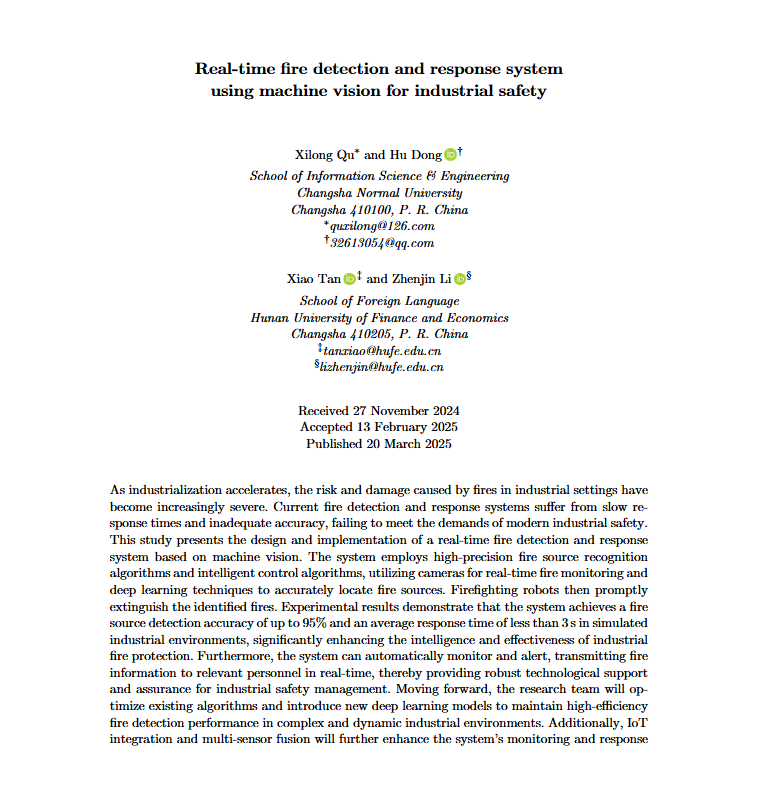
Researchers Xilong Qu, Hu Dong, Xiao Tan, and Zhenjin Li describe a real-time fire detection and response system built for industrial safety, combining machine vision with robotic suppression.
Key ideas:
- The system pairs computer vision with robotics. Cameras monitor an industrial site in real time, deep learning models locate the fire source, and firefighting robots are dispatched to extinguish it.
- In simulated industrial environments, the system reached a fire source detection accuracy of up to 95%, with an average response time of less than 3 seconds.
- The system also handles the alerting side, automatically monitoring conditions and transmitting fire information to relevant personnel in real time.
- The research team's next steps include refining the detection algorithms, adding new deep learning models, integrating IoT and multi-sensor fusion, and testing the system at real industrial sites to see how well it generalizes to other high-risk environments.
Siemens on Fire Protection for AI-Scale Data Centers
This piece walks through why data center growth is increasing the need for more ample fire protection, and how detection and suppression technology plays an important part too.
Key ideas:
- Data center capacity is set to expand rapidly. The article points to average annual growth of 14% between 2026 and 2030, adding roughly 100 gigawatts of capacity worldwide, or about double what exists today.
- Dense electrical systems, complex cooling infrastructure, high-density cabling, and the chemicals inside energy storage systems mean a single spark or thermal anomaly can escalate quickly.
- Aspirating smoke detectors can catch a battery starting to smolder well before it becomes visible. Real-world data shows detection 28 to 32 minutes ahead of thermal runaway, the volatile chain reaction in lithium-ion batteries that's notoriously hard to stop once it starts.
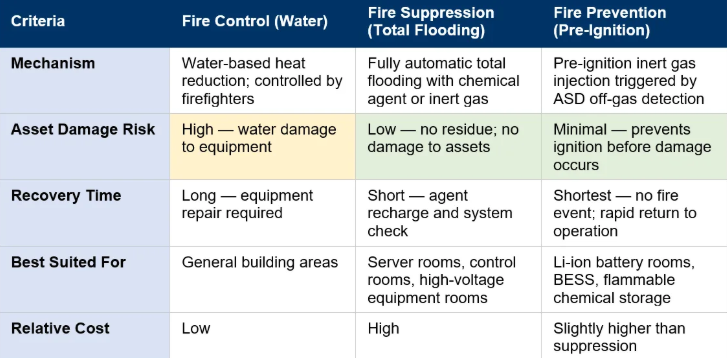
- No single fire protection system suits every data center room. The article walks through three categories: water-based fire control systems that are cheap but risky around electronics, total-flooding suppression systems that use chemical or inert gas agents to protect high-value rooms like server rooms without water damage, and fire prevention systems that release nitrogen gas at the first sign of battery off-gas to stop ignition before it starts, offering the shortest recovery time of the three.
For a closer look at the technology decisions this involves, Siemens' white paper, Fire Protection in Data Centers , focuses on early detection and dry extinguishing systems, with a detailed section on aspirating smoke detectors.
Siemens also published a 49-minute video walkthrough , covering data center industry trends, room-specific applications, and product solutions.
NIST on Forecasting Flashover Before It Happens
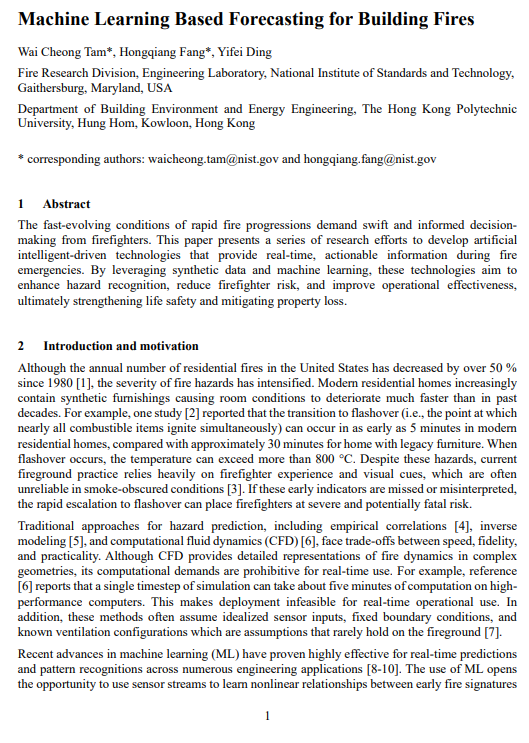
In this paper, researchers Wai Cheong Tam, Hongqiang Fang, and Yifei Ding lay out NIST's Artificial Intelligence-Enabled Smart Fire Fighting project, a multi-year effort to give firefighters real-time, actionable predictions during structure fires.
Key ideas:
- Firefighters still rely heavily on experience and visual cues to judge conditions, which the researchers note are often unreliable in smoke-obscured rooms, and traditional prediction methods like computational fluid dynamics are too computationally heavy to run in real time on the fireground.
- To train machine learning models without relying on scarce full-scale fire tests, NIST built two synthetic data generators, CData and FD-Gen, that simulate thousands of fire scenarios across varied room layouts, fuel types, and ventilation conditions.
- Three models mark NIST's progress on flashover prediction: P-Flash reconstructs temperature readings lost when heat detectors fail and predicts flashover within about 20 seconds of the actual event in roughly 83% of cases; P-Flashv2 adds arbitrary door and window changes and reaches about 88% to 90% accuracy for 30- and 60-second-ahead forecasts; and FlashNet generalizes across 17 different building layouts using a graph neural network, reaching about 92% accuracy at a 30-second lead time.
- NIST is also building interpretability tools, including xFlashNet and a DeepLIFT-based framework, so firefighters can see which sensor data drove a given prediction. The next phase of the work aims to combine these forecasts with reinforcement-learning-based path planning to generate real-time evacuation routes.
International Fire and Safety Journal on Smart Fire Detection in 2026
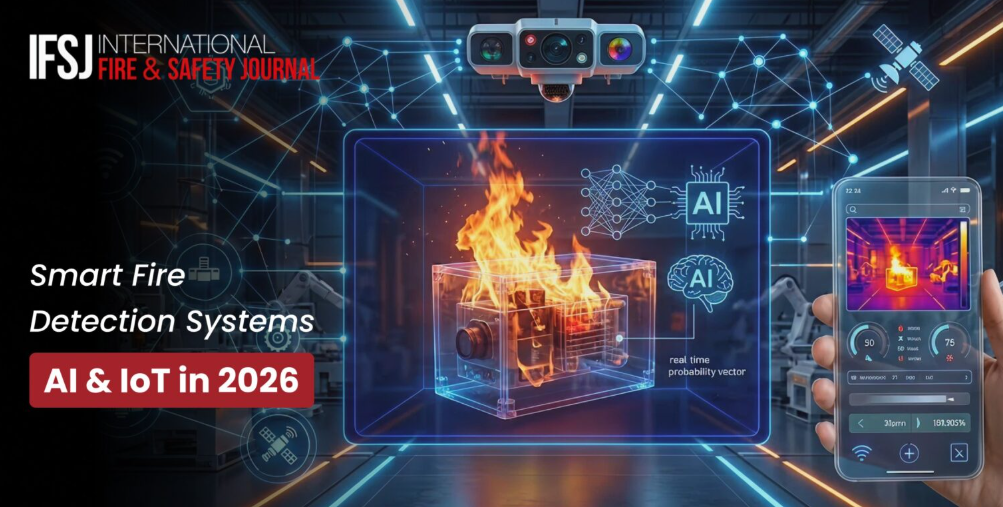
In the International Fire and Safety Journal, Iain Hoey surveys how AI and IoT are reshaping fire detection.
Key ideas:
- False alarms remain a major drag on fire safety systems with rates as high as 97% to 98% of automatic fire alarm activations, with U.S. fire departments responding to more than 2 million false alarms a year.
- The fix is layering signals instead of trusting a single trigger. Smart systems combine three layers: sensors collecting data on smoke, heat, gas, and air quality; AI models that use metrics like false rejection rate and false alarm rate to tell real fires from steam or dust; and IoT connectivity that shares alerts across a building in real time.
- Addressable fire alarm systems give each device its own identity, so response teams get an exact location instead of just a zone, and they're increasingly paired with wireless detection systems that make it easier to retrofit older buildings.
- The 2026 edition of NFPA 72 and Europe's EN 54 are both placing more weight on cybersecurity for networked fire systems, on top of existing documentation and performance requirements, as detection hardware becomes another set of connected devices on the network.
Looking Ahead
Knowing about a fire sooner is worth more than fighting it harder. Firefighters need seconds of warning, not minutes, and those seconds come from better data. To complicate things, a data center, a factory floor, and a road tunnel don't fail the same way, so the sensors, suppression agents, and response plans built for one won't necessarily work for another. As buildings keep adding computers, batteries, and automation, specificity becomes more important. Systems with aspirating smoke detectors can catch a battery cell before it smolders into thermal runaway, machine vision and graph neural networks are learning to predict where a fire will go before it gets there, and flashover models are working to provide rapid data.
That's a wrap for this edition of Industry Signals. Have a report, use case, or event you'd like to see featured in an upcoming issue? Send a note via PM. We're always looking to spotlight what's shaping the future of industry, and recommendations from the Xcelerator Community are especially valuable. Your insights and experiences continually shape Industry Signals.
Comments (0)
Popular

Dive in
Related
Blog
Industry Signals: The Factory of the Future: From Concept to Competitive Advantage
Mar 23rd, 2026 • Views 243
External Content
The future of jobs: 6 decision-makers on AI and talent strategies
Jan 22nd, 2026 • Views 4
Blog
Generative AI’s Role in the Future of Industry: Share Your Perspective
By Industry Signals • Sep 4th, 2025 • Views 87
Blog
Mary Meeker’s AI Insights: 10 Trends Reshaping the Future of Manufacturing
By Industry Signals • Jun 5th, 2025 • Views 3.2K
Blog
Industry Signals: The Factory of the Future: From Concept to Competitive Advantage
Mar 23rd, 2026 • Views 243
Blog
Generative AI’s Role in the Future of Industry: Share Your Perspective
By Industry Signals • Sep 4th, 2025 • Views 87
Blog
Mary Meeker’s AI Insights: 10 Trends Reshaping the Future of Manufacturing
By Industry Signals • Jun 5th, 2025 • Views 3.2K
External Content
The future of jobs: 6 decision-makers on AI and talent strategies
Jan 22nd, 2026 • Views 4