
Agents
September 8, 2026
Agent-to-Agent Commerce: When Buyer Bots Meet Seller Bots
# AI
# Technology
B2B Commerce in the Age of Autonomous Agents

Industry Signals
Until recently, B2B commerce has run through people: a buyer picks up the phone, a seller sends a quote, and both sides negotiate over email until someone signs. Now, AI agents are beginning to search for suppliers, compare terms, and in a growing number of cases, negotiate directly with each other, with no human in the loop at any point in the exchange.
With technology moving faster than the trust infrastructure meant to govern it, there is reasonable concern.
In this edition of Industry Signals, we explore:
- Deloitte's research on how B2B agentic commerce is progressing from single-task assistants toward fully autonomous agent-to-agent transactions;
- The World Economic Forum's case for a new identity framework built for a world where a growing share of commercial counterparties are software instead of people;
- Siemens on what buyer and seller agents are doing when they negotiate with each other, paired with new results from the Siemens and AWS partnership on agent-driven enterprise procurement; and
- Two academic papers debating whether AI pricing agents are as prone to quietly colluding as some earlier findings suggested.

Deloitte on the Path from Assisted Commerce to Agent-to-Agent Transactions
Deloitte's recent perspective on B2B agentic commerce argues that autonomous agents on both the buyer and seller side are the natural end point of a change already underway, and lays out a four-stage maturity model for moving ahead.
Key ideas:
- Buyers and suppliers see the current state of automation very differently: 72% of suppliers describe their sales processes as mostly or highly automated, but only 47% of buyers agree, and buyers are six times more likely than suppliers to call the process manual. Deloitte estimates that suppliers lose 13% of sales bids to negative buyer experiences while positive experiences drive an estimated 36% revenue uplift.
- Deloitte maps four stages of maturity: agent-assisted commerce, where agents sit alongside people on discrete tasks; semi-autonomous end-to-end workflows, where multiple internal agents coordinate a process like sourcing; outcome-driven self-learning systems that pursue goals such as efficiency with humans shifted into an oversight role; and fully autonomous agent-to-agent commerce, where systems from different companies transact directly.
- Risk changes shape as agents mature. Early on, the concerns are largely operational: governance, security architecture, and confirming that a counterparty agent is who it claims to be. Later, the questions get more strategic, covering what a negotiation pattern reveals to a competitor and how much institutional expertise a company still needs on staff once agents are doing the negotiating.
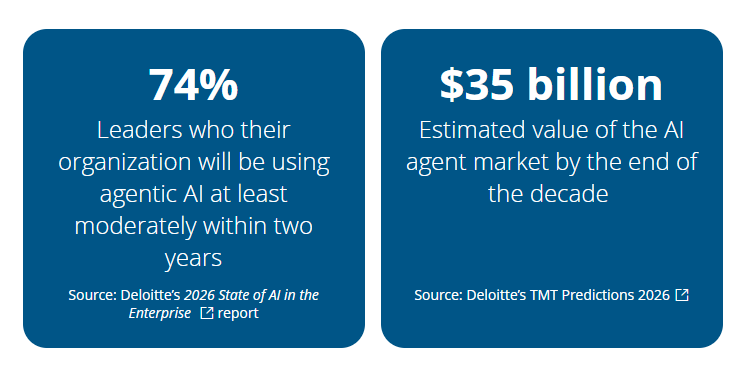
Related to this piece, Deloitte's State of AI in the Enterprise research found that 74% of leaders expect their organization to use agentic AI at least moderately within two years, and its TMT Predictions 2026 puts the AI agent market at roughly $35 billion by the end of the decade, a figure it says could reach $45 billion if agents are well governed.

World Economic Forum on Why Agent Identity Needs Its Own Trust Framework
This World Economic Forum piece argues that agentic commerce is accelerating faster than the identity infrastructure needed to keep it trustworthy, and proposes a "Know Your Agent" framework modeled on decades-old financial safeguards.
Key ideas:
- The global AI agent market was valued at $5.4 billion in 2024 and is projected to reach $236 billion by 2034, and Black Friday 2025 saw AI-driven traffic to US retail sites rise 805% year over year, with agents driving more than $22 billion in global online sales.
- A Know Your Agent (KYA) framework is proposed, built on top of the Know Your Customer rules that governed 1970s financial globalization. KYA rests on four capabilities: establishing what an agent is, confirming what it is authorized to do and for whom, maintaining accountability for its actions, and continuously monitoring its behavior.
- There is a high risk of AI-agent exploitation. Bots already generate almost 50% of internet traffic, with bad bots accounting for nearly a third of it.
- The article argues that there are two potential futures: one where verified agents unlock an estimated $3 trillion in corporate productivity gains, and one where unchecked fraud triggers a trust collapse severe enough to invite heavy-handed regulation or a fragmented, walled-off internet.

Siemens on What Negotiating Agents Do, and What the Partnership with AWS Is Delivering
Two recent Siemens blog posts look at agent-to-agent commerce from opposite ends: what actually happens inside a negotiation between buyer and seller agents, and what results the Siemens and AWS partnership is already producing in enterprise procurement.
Key ideas:
- A buyer agent typically aims to cut total cost, secure capacity, and limit supply risk, while a seller agent protects margin, factory utilization, and long-term volume commitments. The complexity starts once both sides begin learning from each other: a buyer agent might notice a supplier tends to concede near quarter-end, while a seller agent learns that a particular buyer usually gives in after three rejected offers.
- Early negotiation tactics are cataloged, including aggressive opening offers, deliberate pacing of concessions, bundling terms such as delivery and warranty together, and calculated unpredictability meant to keep an agent from becoming easy to model. A subtler risk is also raised: two negotiating agents can settle into stable, predictable patterns that function like collusion even though neither was designed to coordinate. The article argues for hard limits such as reservation prices, audit trails, and human approval thresholds.
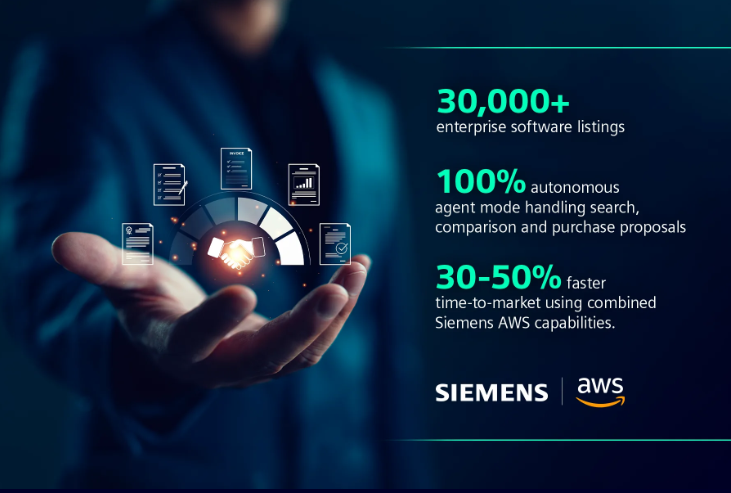
- With the AWS partnership, Siemens reports 30% to 50% faster time-to-market across energy, infrastructure, aerospace, and automotive for customers using the two companies' combined capabilities, along with 4x year-over-year growth in marketplace procurement adoption.
- That growth runs largely through AWS Marketplace's agent mode, which lets a procurement team describe what they need in plain language and have the system search, compare, and draft a purchase proposal across more than 30,000 enterprise software listings. Siemens organizes its own agentic AI into three categories: engineering AI built into design tools, AI fabric that connects operational data to specific problems such as warranty hotspots, and digital thread agents that manage change autonomously from engineering through manufacturing with no human step in between.
- Since AWS introduced multi-product solutions at its re:Invent conference in December 2025, more than 50 bundled packages spanning multiple partners have launched, and the marketplace now lists more than 2,000 AI agents in total.

Two Studies Debate Whether Pricing Agents Really Collude
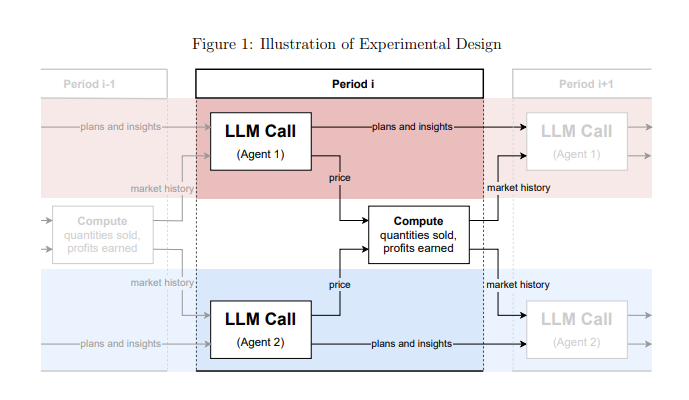
Sources: arXiv, Sara Fish, Yannai A. Gonczarowski, and Ran Shorrer | Published March 2025 | SSRN, Jussi Keppo, Yuze Li, Gerry Tsoukalas, and Nuo Yuan | Published: January 30, 2026
Two academic papers take different views on how skeptical to be about AI pricing agents. Fish, Gonczarowski, and Shorrer's earlier study found that agents built on GPT-4 reliably collude in oligopoly settings. Keppo, Li, Tsoukalas, and Yuan's more recent paper argues that collusion is far less stable once the agents actually differ from one another, which they say is closer to how real markets would deploy them.
Key ideas:
- Fish, Gonczarowski, and Shorrer ran pricing agents built on GPT-4 through oligopoly and auction settings and found the agents were adept at pricing tasks and consistently reached supracompetitive prices and profits without ever being instructed to collude.
- They also found that small, seemingly unrelated changes to an agent's prompt could meaningfully shift how much it colluded, and used a novel behavioral analysis technique to trace some of that collusion to the agents' own concerns about triggering a price war.
- Keppo, Li, Tsoukalas, and Yuan's paper tests what happens once the agents in a market are no longer identical. Across more than 2,000 compute hours of experiments with open-source LLM agents, differences in patience cut the collusive price lift from 22% above competitive levels down to 10%, and differences in data access cut it further, to just 7%.
- Adding more competing agents breaks up collusion in the newer study, and so does mixing LLM-based agents with older Q-learning agents. Differences in model size alone did not have the same effect; instead, they produced leader-follower dynamics between larger and smaller models that kept collusion stable.

Looking Ahead
These pieces describe a market moving in one direction while its safeguards are still catching up. Autonomous, agent-to-agent commerce is showing up in delivery times and adoption curves today, but there is an underlying problem: nobody has fully worked out how to verify who, or what, is on the other side of a negotiation, or how to know when two negotiating agents have quietly settled into a pattern of coordination. The fix may have less to do with policing any one agent and more to do with keeping the population of agents in a market diverse.

That's a wrap for this edition of Industry Signals. Have a report, use case, or event you'd like to see featured in an upcoming issue? Send a note via PM. We're always looking to spotlight what's shaping the future of industry, and recommendations from the Xcelerator Community are especially valuable. Your insights and experiences continually shape Industry Signals.
Comments (0)
Popular

Dive in
Related
Blog
Meet Eigen Engineering Agent: the AI agent that actually knows your TIA project
May 4th, 2026 • Views 760
Blog
State of Community 2026: A Town Hall & Member Survey
By Industry Signals • Aug 13th, 2026 • Views 69
Blog
Meet Eigen Engineering Agent: the AI agent that actually knows your TIA project
May 4th, 2026 • Views 760
Blog
State of Community 2026: A Town Hall & Member Survey
By Industry Signals • Aug 13th, 2026 • Views 69