
Space
June 25, 2026
The Space Economy Has Entered Your Industry
# Aerospace
# AI
# Automation
# Automation & Digitalization
# Connectivity
# Data Centers
# Digital Transformation
# Ecosystem & Collaboration
# Industrial AI
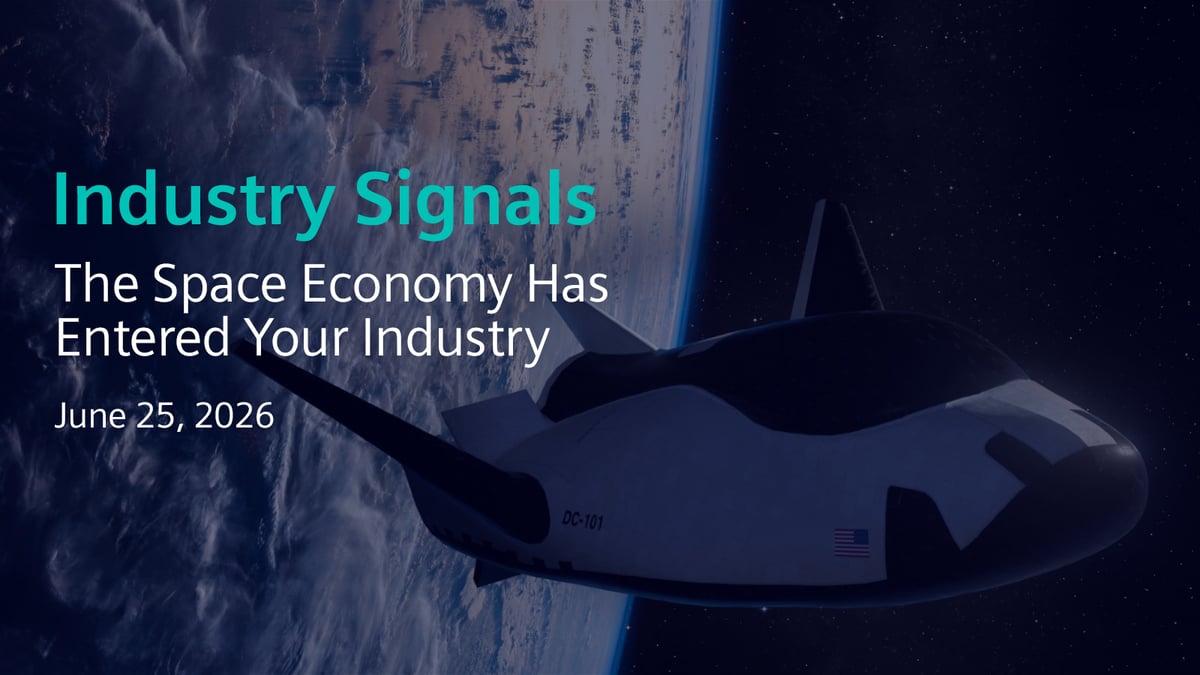
Space: From Government Frontier to Industrial Infrastructure

Industry Signals
Space is becoming an industrial infrastructure, thanks to falling launch costs and increasing commercial investment. This edition of Industry Signals covers the engineering tools helping space startups scale, the commercial markets now outspending governments across most of the space economy, the $263 billion in Earth observation value that remains unrealized, and the coming together of satellite and mobile networks that is turning into connectivity industries can rely on almost anywhere.
For most of its history, space was somewhere only governments went, but now it is becoming operational infrastructure for industries that have never built a satellite. Commercial spending has overtaken government spending and the data and connectivity flowing back to Earth are turning up in factories, insurance models, shipping lanes, and farm equipment. This is much in part thanks to reusable rockets, which have reduced the cost of reaching orbit greatly.
In this edition of Industry Signals, we look at:
- McKinsey on why commercial markets are now outspending governments across most of the space economy;
- Siemens and the European Space Agency on lowering the engineering barriers that keep space startups from scaling;
- The World Economic Forum and Deloitte on the $263 billion in Earth observation value that remains unrealized; and
- Capgemini on how non-terrestrial networks are pulling satellite connectivity into everyday industrial operations.

McKinsey on Commercial Markets Overtaking Government Spending
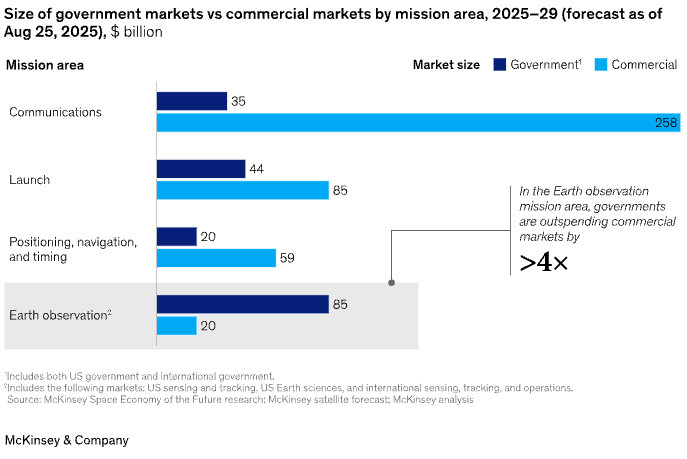
McKinsey's defense-blog analysis finds that commercial spending has pulled ahead of government spending across most space end markets, and it projects the gap to widen through the second half of the decade.
Key ideas:
- Through the back half of the decade, McKinsey expects commercial markets to outspend governments by at least two to one in almost every end market. In communications, the forecast puts the commercial market at $258 billion against $35 billion for government across 2025 to 2029.
- Launch is being reshaped by rising volumes and reusability. Commercial launch revenues are projected to reach $32 billion by 2035, while heavy-lift and reusable platforms could cut launch costs by 40 percent per kilogram of payload between 2023 and 2035.
- High-precision positioning, navigation, and timing is drawing commercial money into applications such as surveying, autonomous navigation, and precision agriculture. McKinsey projects receiver revenues to more than double to $95 billion by 2035, with software-tool revenues nearly quadrupling to $25 billion.
Commercial customers, with the larger demand, will increasingly set the innovation agenda that government players will have to keep pace with.

Siemens and ESA on Lowering the Barriers for Space Startups
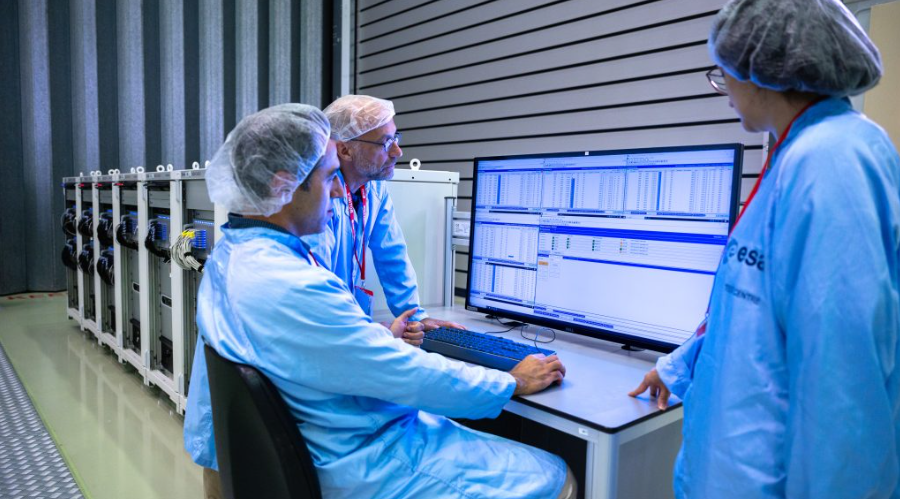
Siemens announced a partnership with the European Space Agency that gives startups in ESA's Business Incubation Centres access to the Simcenter simulation portfolio, and it set the move against the economics now drawing entrepreneurs and investors toward space.
Key ideas:
- The figures cited in the piece show a market that has grown enough to attract serious commercial capital: the global space economy reached $613 billion in 2024 and is projected to pass $1 trillion by 2032, with 78 percent of that activity driven by the commercial sector. Europe's share of global private space investment climbed from 3 percent in 2019 to 22 percent in 2024.
- SpaceX's reusable rockets cut launch costs by roughly 75 percent, from about $10,000 to $2,500 per kilogram, which reset the economics for everyone building hardware that leaves the ground.
- The risk remains high because space ventures carry long development cycles and heavy upfront capital. A single launch failure can destroy an entire asset.
- Simulation and digital twins are how teams manage that risk, because a spacecraft cannot be fully tested on the ground and physical prototypes are too expensive to iterate when each failure runs into the millions. Through the ESA partnership, startups in the Business Incubation Centres receive the Simcenter portfolio on terms well below standard commercial rates, tapered over two to three years, along with training through the Siemens Xcelerator Academy and mentorship from aerospace simulation engineers.
- The same tools are already in use across the startup tier. Reaction Dynamics in Canada is working on hybrid rocket propulsion with Simcenter 3D and NASTRAN, Astroscale in Japan is tackling debris removal with Simcenter Femap, and a student team in Greece achieved a 30 percent mass reduction in a CubeSat payload structure using Simcenter 3D.
If this interests early-stage founders in the community, the ESA Business Incubation Centres network page lists centres by country along with the eligibility and application steps.

The World Economic Forum and Deloitte on Earth Observation's Unrealized Value

Written with Deloitte, this report estimates that Earth observation already contributes about $440 billion to global GDP, with a further $263 billion in annual value still unrealized, and it argues the remaining gap is now a question of adoption.
Key ideas:
- Earth observation's full annual potential is around $703 billion. About $440 billion is captured today, which leaves more than 37 percent, up to $263 billion, on the table. It is thought that this is because the insights struggle to reach the systems where decisions are made.
- The unrealized value splits across three linked domains: acquisition ($84 billion), processing ($117 billion), and deployment ($62 billion). Processing is the largest share, since raw observations often exist but have not been turned into a product a decision-maker can act on with confidence.
- Precision agriculture is the single biggest opportunity at $136.7 billion in unrealized value, more than half the total, covering cropping, fishery, livestock, and timber management. The headroom now comes from making outputs usable at the level of an individual farm or field.
- Speed determines value in time-critical applications. The report cites the World Meteorological Organization's finding that a 24-hour advance warning of a natural hazard can reduce the resulting damage by roughly 30 percent, a benefit that only holds when the signal arrives inside the decision window.

Capgemini on Non-Terrestrial Networks and Industrial Connectivity
Capgemini examines how satellite and mobile networks are coming together into non-terrestrial networks, letting ordinary devices connect through space and turning connectivity into something industries can rely on almost anywhere.
Key ideas:
- Mobile and satellite operators are partnering to deliver direct-to-device coverage that reaches well beyond cell towers, with an evolving set of 3GPP standards (5G NR NTN and NTN NB-IoT) stitching the two ecosystems together.
- Starlink reset the economics by flying a large low-Earth-orbit constellation of smaller, cheaper satellites that hand signals between one another for lower latency. Its partnership with T-Mobile in the US showed that everyday 4G and 5G phones can reach satellites directly using a thin slice of L- and S-band spectrum, what the piece calls a "cell tower in the sky."
- By the second half of the decade, standard smartphones could move between terrestrial and satellite networks without the user noticing, closing coverage gaps at near-equivalent service levels.
- For industrial users, the practical effect is that connectivity can be treated as a global constant. That supports connected vehicles across remote terrain, private 5G extended to offshore rigs and mining sites through satellite backhaul, and IoT sensors deployed in places cellular networks never reached.

Looking Ahead
Falling launch costs and commercial demand are pulling space out of an era when only governments could afford it, and the value coming back to Earth is increasingly industrial: observation data that feeds agriculture, insurance, and supply chains, and connectivity that reaches the factory floor and the offshore rig. Organizations on the ground now have the opportunity to connect orbital capability to ground-level decisions with the help of engineering simulation, data pipelines, and systems integration.
That's a wrap for this edition of Industry Signals. Have a report, use case, or event you'd like to see featured in an upcoming issue? Send a note via PM. We're always looking to spotlight what's shaping the future of industry, and recommendations from the Xcelerator Community are especially valuable. Your insights and experiences continually shape Industry Signals.
Comments (0)
Popular

Dive in
Related
Blog
Semiconductors: The Industry Shaping Every Other Industry
By Industry Signals • Mar 13th, 2026 • Views 134
Video
Transforming Industry at the Speed of Software - Mathias Oppelt
By Mathias Oppelt • Jul 15th, 2025 • Views 94
Blog
Generative AI’s Role in the Future of Industry: Share Your Perspective
By Industry Signals • Sep 4th, 2025 • Views 86
Blog
Industry Signals - August 19, 2025: How Circularity is Redefining the Battery Industry
By Industry Signals • Aug 19th, 2025 • Views 161
Blog
Semiconductors: The Industry Shaping Every Other Industry
By Industry Signals • Mar 13th, 2026 • Views 134
Blog
Generative AI’s Role in the Future of Industry: Share Your Perspective
By Industry Signals • Sep 4th, 2025 • Views 86
Blog
Industry Signals - August 19, 2025: How Circularity is Redefining the Battery Industry
By Industry Signals • Aug 19th, 2025 • Views 161
Video
Transforming Industry at the Speed of Software - Mathias Oppelt
By Mathias Oppelt • Jul 15th, 2025 • Views 94