
Robotics & Embodied AI
April 15, 2026
Industry Signals: Robotics
# AI
# Automation
# Digital Transformation
# Ecosystem & Collaboration
# Factory of the Future
# Smart Manufacturing
The Rise of Embodied AI: the Shift from the Screen to the Factory Floor

Industry Signals
For decades, industrial robots have done one thing well: repeat the same motion, precisely and relentlessly, in spaces designed around them. That model still defines most factory automation, but it is no longer the only one. Advances in AI, sensing, actuator hardware, and battery technology are pushing robots into environments built for humans. Robots are doing tasks that change, in spaces that were never modified to accommodate them, and the investments are following fast.
In this edition of Industry Signals, we explore:
- Barclays’ case for humanoid robotics as the next major investment theme in physical AI, including market projections and the cost dynamics driving commercial readiness;
- The International Federation of Robotics' data on global industrial robot installations and the decade-long demand trajectory;
- Research from the RAI Institute on how hands-on robot interaction changes public perception and what that means for deployment in non-industrial settings; and
- How Siemens is engaging with robotics through active partnerships, on-site proof-of-concept deployments, and digital software infrastructure designed to help robot makers scale.

Barclays on Physical AI and the Humanoid Investment Case
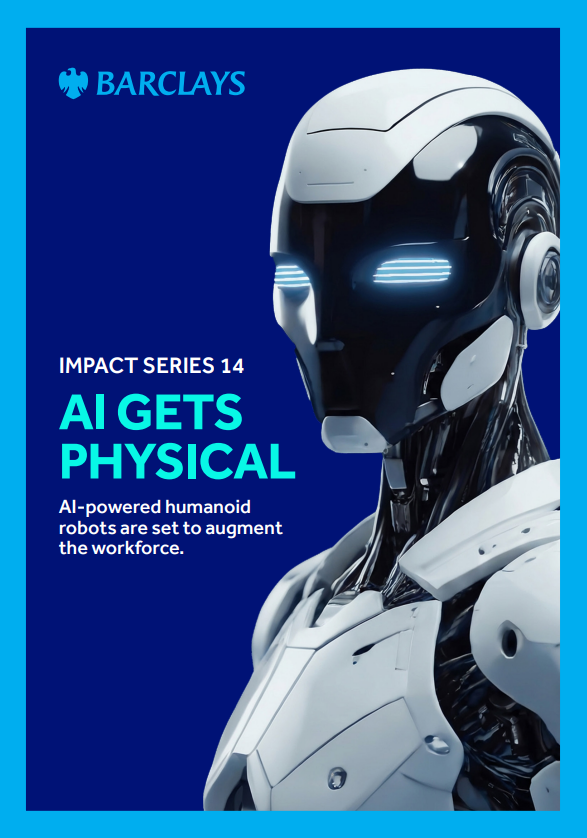
Barclays’ Impact Series report, AI Gets Physical, frames humanoid robotics as the point where AI moves from cognitive processing into the physical world. The report identifies it as the next major industrial investment theme after a decade dominated by software.
Key ideas:
- Breakthroughs across AI reasoning, actuator technology, and battery systems have cut humanoid production costs roughly 30-fold over the past decade, a cost collapse that is opening the door to commercial adoption at scale.
- Barclays frames the humanoid opportunity as one of workforce augmentation, where automating routine or physically demanding tasks lets people focus on higher-value activities while maintaining critical oversight.
- AI investment has been concentrated on software and hyperscalers, but is shifting to an emphasis on hardware.
For a Deloitte perspective that complements the Barclays investment case, check out this short video featuring US Chief Technology Officer Bill Briggs and NExT Leader Raquel Buscaino. Where Barclays focuses on market size and supply chain opportunity, Briggs and Buscaino examine what physical AI actually does in practice: how AI-enabled robots learn in complex environments and what that means for safety, precision, and the nature of work itself.

IFR on Global Industrial Robot Demand
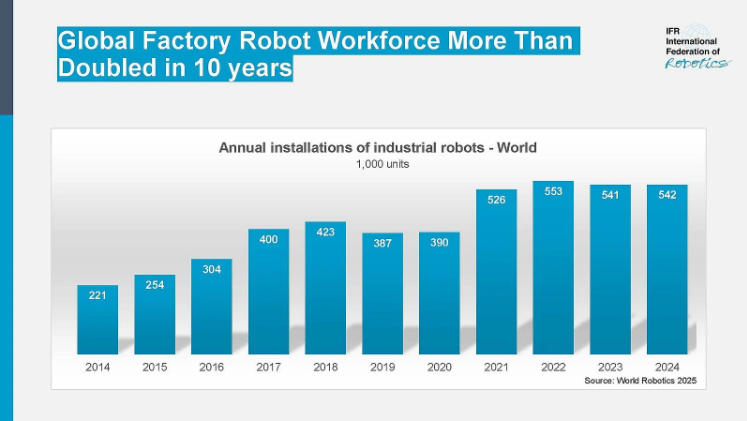
The IFR's World Robotics 2025 report on industrial robots provides the clearest picture of where the installed base stands and what the deployment trajectory looks like heading into the humanoid era.
Key ideas:
- 542,000 robots were installed in factories worldwide in 2024, more than double the figure from a decade ago. Annual installations have topped 500,000 units for the fourth consecutive year, and the total number of industrial robots in operational use worldwide reached 4,664,000 units (a 9% increase year on year).
- Globally, robot installations are expected to grow 6% to 575,000 units in 2025, and IFR projects the 700,000-unit mark will be surpassed by 2028. The IFR notes that while regional trends vary, the aggregate long-term growth trajectory remains positive despite geopolitical and macroeconomic headwinds.

RAI Institute on What Hands-On Experience Does to Public Perception
The hardware and software problems of robotics get most of the attention, whereas the human side (how people actually feel about robots and what changes those feelings) is harder to study and thus, rarely makes it into industry coverage. Research from the RAI Institute presented at the 2026 ACM/IEEE International Conference on Human-Robot Interaction offers some of the clearest data yet on what happens when people move from watching robots to operating them.
Key ideas:
- In summer 2025, the RAI Institute set up a free pop-up robot experience at the CambridgeSide mall in Boston, giving members of the public the chance to drive a Spot quadruped through a themed arena.
- Five contexts, including factory, home, hospital, office and outdoor/disaster, were tested. Comfort scores increased significantly after the driving session. The gains were consistent across age groups and genders and held up after statistical correction for multiple comparisons.
- People started most skeptical of home, office and hospital contexts, but ended up reporting feelings of these areas being more suitable for robots after the test drive, suggesting that hands-on experience shifts a person's underlying sense of what robots can do and where they belong.
- Post-interaction emotional responses were notably positive: 74% of participants reported excitement, 50% reported happiness, and only 12% reported nervousness. When asked what tasks they would want a robot to perform, answers shifted after driving.

Siemens at the Center of the Humanoid Transition
Across partnerships, on-site deployments, and software infrastructure, Siemens is actively involved in solving the problems that stand between humanoid prototypes and production-scale deployment.
Humanoid and Siemens: A Proof of Concept in Industrial Logistics
UK-based robotics company Humanoid and Siemens completed a proof of concept demonstrating the use of humanoid robots in industrial logistics. Humanoid's HMND 01 wheeled Alpha robot was deployed in real operations at Siemens' Electronics Factory in Erlangen, where it performed a tote-to-conveyor destacking task — autonomously picking totes from a storage stack, transporting them to a conveyor, and placing them at the designated pickup point for human operators.
Key ideas:
For a ground-level look at what the Siemens–Humanoid proof of concept actually looked like in practice, check out this video . Filmed inside the Siemens Electronics Factory in Erlangen, it shows the robot performing the tote-to-conveyor logistics task in a live production environment, and covers why that specific task was chosen, what the ergonomic case for automation looks like from the factory floor, and what the results reveal about how close humanoids are to becoming a routine part of industrial operations.
UBTech and Siemens: Digital Infrastructure for Mass Production
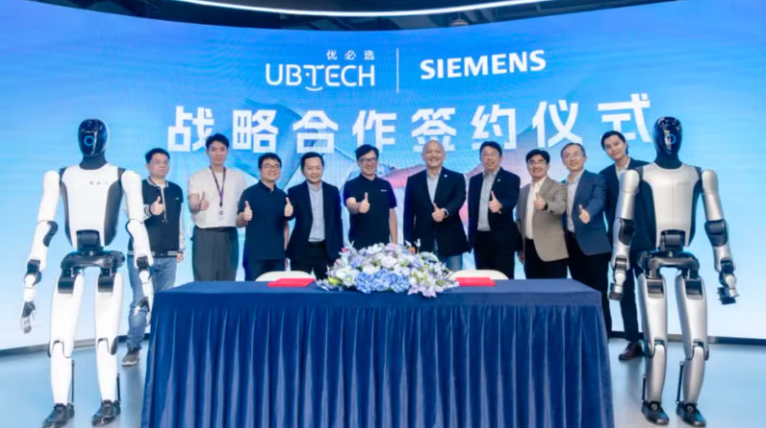
Chinese humanoid robot manufacturer UBTech Robotics entered a strategic partnership with Siemens with the goal of helping UBTech achieve its target of producing more than 10,000 industrial humanoid robots in 2026. Siemens is providing digital industrial software solutions spanning product research, design, and manufacturing, intended to streamline the digital workflow between UBTech's R&D and production processes.
Key ideas:
- UBTech CEO Zhou Jian described market demand for humanoid robots as having "continued to unleash" in 2026, with a significant increase in orders driving urgency around scaling production capacity. The Siemens partnership is described as a key measure toward achieving the 10,000-unit target.
- As humanoid manufacturers move from prototype to production, digital tools for workflow integration, quality management, and design iteration are becoming as consequential as the hardware itself.

Further Reading/Resources
For practitioners and researchers tracking the technical frontier of robotics, the MDPI Robotics journal is worth bookmarking. It is an open-access publication covering algorithms, sensing, actuation, and autonomous systems, and it offers peer-reviewed research across the full range of robotics subfields, useful for teams who want to track methodological advances alongside the commercial news cycle.
The Siemens Thought Leadership blog on humanoids and the recent Industry Forward Podcast episodes ( The Major Shift Toward Humanoids and Humanoids: Automation That Fits ) with Dale Tutt and Rahul Garg are also worth taking a peek at. They offer a practitioner-level perspective on what humanoid integration actually requires, covering brownfield deployment challenges, the role of simulation, and how to think about humanoids alongside existing automation investments.

Looking Ahead
We know what robots can do in controlled conditions, and now we are finding out what it takes to put them to work at scale, in real environments, alongside real people: digital infrastructure that can support design, simulation, and validation before a robot touches the production floor; manufacturing pipelines capable of moving from thousands of units to tens of thousands; workforces that are prepared to collaborate with machines; and taking seriously the human dimension and how we can prepare people to share their workplaces with robots.

That's a wrap for this edition of Industry Signals. Have a report, use case, or event you'd like to see featured in an upcoming issue? Send a note via PM. We're always looking to spotlight what's shaping the future of industry, and recommendations from the Xcelerator Community are especially valuable. Your insights and experiences continually shape Industry Signals.
Comments (0)
Popular

Dive in
Related
Blog
Industry Signals - November 11, 2025: Autonomous Robots, Flexible Warehousing, and Industry Standards
By Industry Signals • Nov 11th, 2025 • Views 227
Blog
Industry Signals: The Factory of the Future: From Concept to Competitive Advantage
Mar 23rd, 2026 • Views 179
Blog
Industry Signals - August 19, 2025: How Circularity is Redefining the Battery Industry
By Industry Signals • Aug 19th, 2025 • Views 163
Blog
Industry Signals – September 30, 2025: Digital Innovation in Aerospace and Defense
Sep 30th, 2025 • Views 132
Blog
Industry Signals - November 11, 2025: Autonomous Robots, Flexible Warehousing, and Industry Standards
By Industry Signals • Nov 11th, 2025 • Views 227
Blog
Industry Signals - August 19, 2025: How Circularity is Redefining the Battery Industry
By Industry Signals • Aug 19th, 2025 • Views 163
Blog
Industry Signals – September 30, 2025: Digital Innovation in Aerospace and Defense
Sep 30th, 2025 • Views 132
Blog
Industry Signals: The Factory of the Future: From Concept to Competitive Advantage
Mar 23rd, 2026 • Views 179