
Innovation and Future Resources
June 2, 2026
From One Game to Many: Inside the 10F Consortium's Open-Source Forecasts
# Futures
# AI
# Energy & Sustainability
# Supply Chain
# Industrial AI
Scott Smith and Susan Cox-Smith of Changeist return to the community to talk about the 10F Consortium, the open-source forecasts behind it, and what a fragmented world asks of the people who build things.

Bill Johnston
The eyes of the world are on the Straight of Hormuz, as the tankers that carry a significant supply of the world’s oil sit idle. Underneath the same water, a different type of critical cargo flows through the seven submarine cables carrying the internet and financial traffic that ties the Gulf states and their fast-growing AI data centers to the rest of the world. In a recent interview with the Siemens Xcelerator Community, Scott Smith of Changeist points to this non-obvious dependency: when conflict flares in the strait, it is no longer only ships being affected but data centers being impacted and traffic being rerouted. The chokepoint has not moved, but what passes through it has. In the age of digital transformation, leaders believe that goods, energy, and information can move freely and reliably across borders. That premise no longer holds. Geopolitics have intervened.
The Strait is one instance of a broader pattern: forces once treated as background now shape the foreground. The 10F Consortium set out to map it. Convened by Changeist in 2025, it gathered twenty futurists and policy researchers in Singapore for two days and published ten forecasts on the coming decade, under an open license for anyone to use.
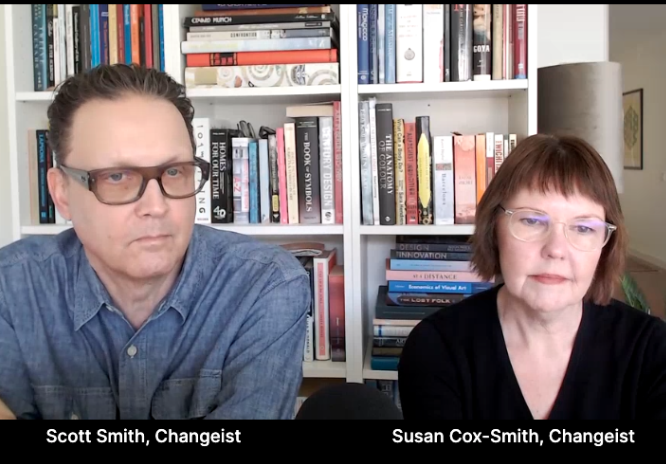
Susan Cox-Smith describes the current situation. “What used to be applicable for every interaction, whether it’s client-facing, internal, or partnership-based, is now dependent on which client, which team, and which partner is being negotiated with.” Everyone used to play one game by one set of rules; now there are three or four, and they no longer reconcile.
When the two of them last spoke with this community, the argument was that foresight should be an everyday cultural practice rather than an occasional offsite, the headlights switched on for five minutes every few years. The 10F Consortium is that same argument carried out at the scale of a whole field: a standing, shared body of work practitioners can return to instead of rebuilding from scratch each time.
The rules stopped reconciling
The cost of running an organization under several rulebooks at once is, in Cox-Smith's telling, under-discussed. "Leaders aren't just navigating more complexity," she notes, "they're navigating complexity that won't resolve." There is no waiting it out; operations keep running while the rules are rewritten. Within organizations, the strain shows up as asymmetry, with some people quietly working in the new game while publicly acknowledging only the old one.
A few, Scott Smith adds, genuinely believe the old order will return, and he is skeptical the wish survives contact with reality. There is a comforting story going around, he says, that if we hold on long enough, through the next election or the next cycle, things will go back to where they were. They will not, in his view, and they probably should not, because once you strip out enough of the old supports and the old wiring, you find that some of those arrangements were not serving the communities they were built for in the first place. The honest framing, he and Cox-Smith hold, is that this is change going forward, not change going back.
Ten forecasts, designed to be modular
The consortium picked the ten areas it judged to be shifting fastest: transparency, ideology, solidarity, alliances, climate adaptation, civil society, migration, energy, money, and technology stacks. Each follows a "from X to Y" structure: the old assumption, what replaces it, what it means for those caught in the shift. The forecasts are free and modular. "You can take as much or as little as you want or need," Cox-Smith says, "and not every forecast will be relevant to everyone's needs." There is, she adds, "really no wrong way to engage with them."
A framework for finding your footing
AREAS came out of the work itself. Because actors do not all play the same part in a shift, the consortium named the parts: you can Architect a shift, Resist it, Exploit it, Avoid it, or be Shaped by it. The roles are not fixed; a group shaped by one forecast may architect another, so AREAS shows both where you stand and where you might move.
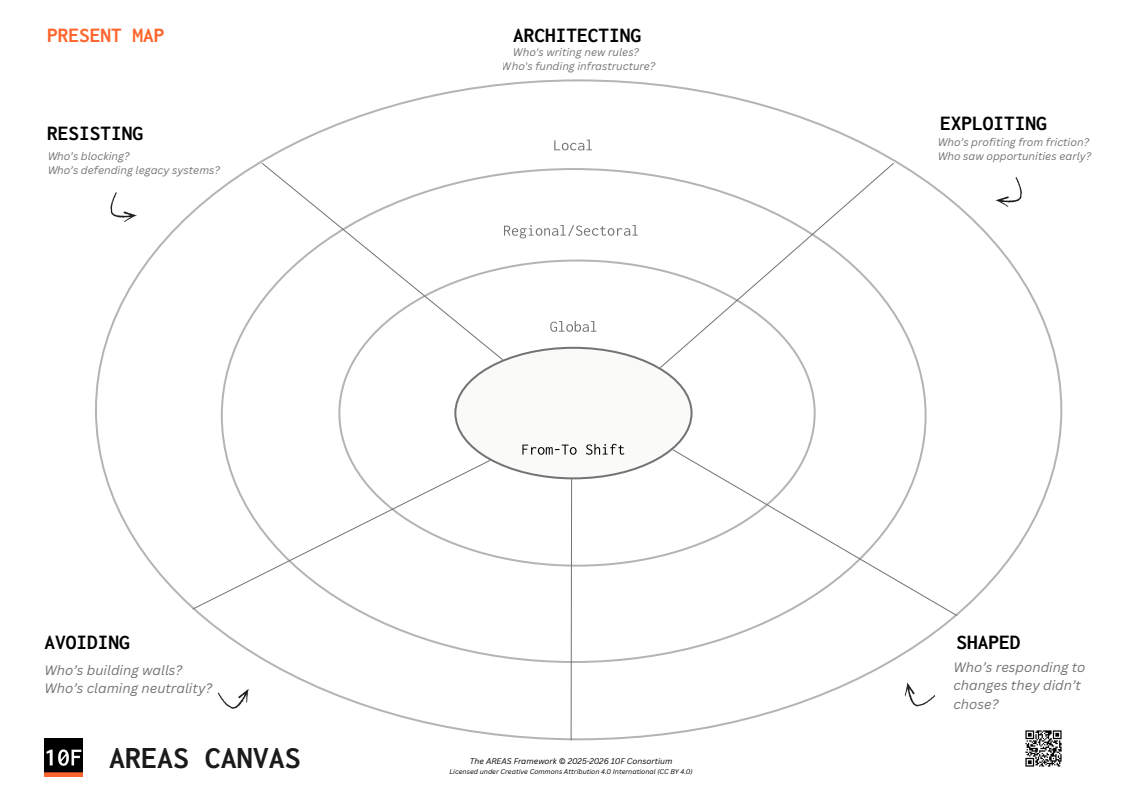
AREAS works in large corporations and, just as well, in grassroots groups within a single neighborhood. Scott calls it “a really useful knife to cut through a lot of complexity.”
Why AI is the weather, not the subject
One of the most challenging editorial decisions was what the forecasts left out. There is no standalone AI forecast, and no standalone climate forecast either, a choice the group argued out face-to-face in the workshop room. "You can swing a cat and find an AI forecast," as the Smiths put it. They treated both as conditions instead. Climate is the weather, literally; AI is the weather in the other sense, running through nearly every topic. Brian compared it to the early days of social media, when firms wrote "social media strategies" until someone pointed out it was a tool, not a strategy. The question is what AI does to everything else.
What it means for industry
The forces in the 10F Framework don't stay abstract for long. Scott uses migration as an example: the more consequential movement isn't lower-skilled workers crossing borders, but high-skilled talent — and governments are starting to treat that movement as a policy lever. The consortium calls this sovereign labor: the power to restrict which segments of the workforce can move freely across borders. Add energy infrastructure to the mix, where electro-states are displacing petro-states as the dominant power model, and a product or market decision quickly becomes a question of whose rules apply, whose grid you depend on, and whose data governance you're operating under.
The Xcelerator community has a concrete example close to home. The new partnership between the Farm Tech Society and Siemens — exploring the future of controlled environment agriculture — sits at exactly the intersection of energy, climate, trade, and policy that the 10F Framework maps. For a leader working in any field shaped by forces like these, that kind of intersectional thinking isn't optional background reading.
The human element
Some of what the consortium found is difficult to raise inside a planning cycle. Cox-Smith’s beat at Changeist is the human side — people, health, and wellbeing — and what she sees is how much of this change has become a drain on ordinary lives, in time and money both, and how poorly most of us are prepared for the idea that it does not reverse. The current fixation on nostalgia, she suggests, is a symptom of exactly that. People want to go back to the decade they remember, “and it’s like, you were 10,” she says of the ’90s revival. And unfortunately, the past tends to look smoother than it actually was.
Her counsel is not to take it personally. In good times, it is easy to feel that history owes you smooth sailing, and the more useful posture is to accept that you may simply be living through a period of change, find the far side of it, and work out how to get there. Each forecast ends with adaptive strategies, and the ones that hold up cluster around "mutual aid and small network cooperation and the resurgence of communities for support."
Which is roughly where the conversation wound down, on the question of whether any of this work is still needed in an age of capable machines. The temptation, Smith says, is to think "we don't need these foresight people anymore; we can go to Claude and ask, or ChatGPT," what comes next, and the trouble is that it offers a false sense of capability while quietly shaping the very discourse it claims to read. Bill put the limit plainly: these models read the past with great clarity because they are trained on it, and obviously contain no facts about the future. That is the case for foresight as a human discipline, and the reason twenty people thought it worth hundreds of hours to do the work in the open.
Find and use the work
10F Consortium
The ten forecasts, the AREAS framework, and a weekly newsletter live at 10fconsortium.org , with the forecasts and a set of prompts for running your own analysis posted to GitHub.
Changeist
More information about Changeist is at changeist.com .
A video of the full conversation appears below.
Comments (0)
Popular

Dive in
Related
Blog
Industry Signals: The Factory of the Future: From Concept to Competitive Advantage
Mar 23rd, 2026 • Views 130
Video
[Video] From Gaming to Industry: David Erhard on the Community-Building Mindset
By David Erhard • May 20th, 2026 • Views 88
Blog
Industry Signals: The Factory of the Future: From Concept to Competitive Advantage
Mar 23rd, 2026 • Views 130
Video
[Video] From Gaming to Industry: David Erhard on the Community-Building Mindset
By David Erhard • May 20th, 2026 • Views 88