
Sustainability
November 25, 2025
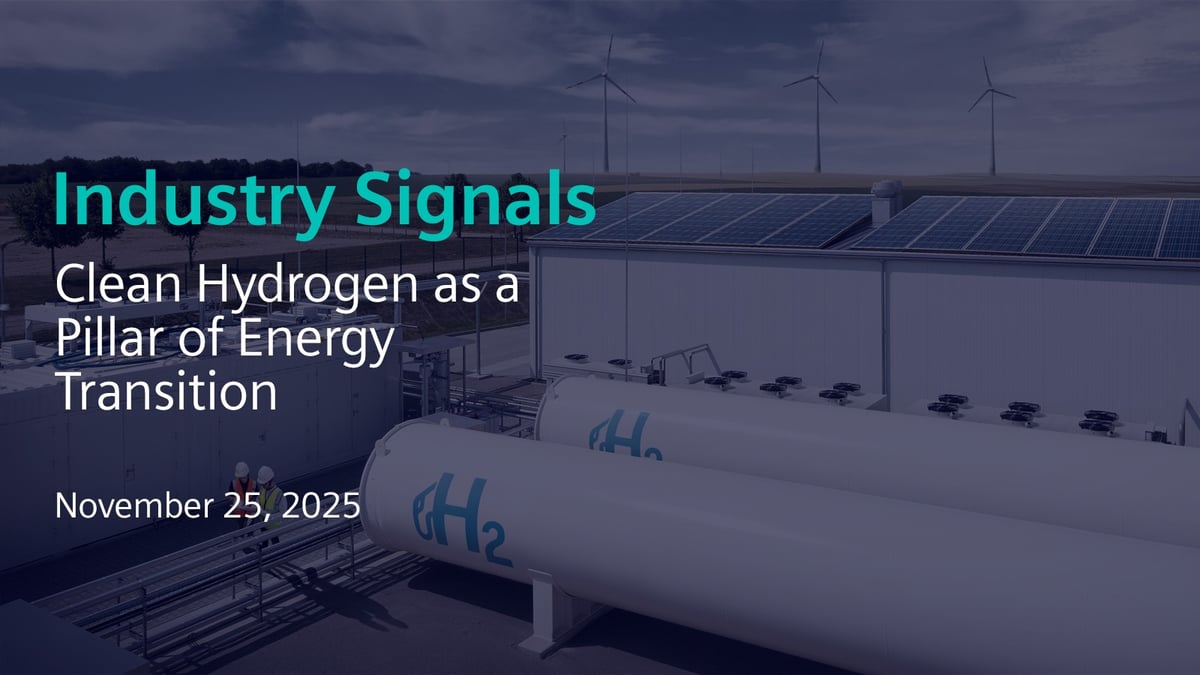
Clean Hydrogen as a Pillar of Energy Transition
# Automation
# Digital Transformation
# Digital Twin
# Energy
# Energy & Sustainability
# Energy Efficiency
# Innovation
# Renewable Energy
# Sustainability
# Water
Hydrogen innovation is moving from experimentation to execution across geographies and industries.

Industry Signals
Clean hydrogen continues to mature as a strategic pillar of the energy transition, but there is still a gap between ambition and adoption. Despite that gap, it seems like industrial hydrogen is nearing a tipping point. The industry is increasingly relying on digital infrastructure, simulation tools, and advanced manufacturing to speed up what used to be decades-long processes, and, because hydrogen’s future cannot rely on technology alone, cost parity, infrastructure coordination, and policy design are being recalibrated.
In this edition of Industry Signals, we look at key developments that are redefining how hydrogen is engineered, scaled, and adopted across industrial contexts, using recent analyses and case studies as our guide:
- Siemens Energy’s notes on developing the first 100% hydrogen gas turbine;
- The Hydrogen Council’s cost-gap report maps a three-tier demand model that reveals where investment and incentives must align; and
- UNIDO’s strategy for emerging markets reframes hydrogen deployment as a development and equity challenge, not just a decarbonization goal.

Siemens’ Notes on Accelerating Hydrogen Innovation with Digital Threads and Additive Manufacturing
Siemens Energy developed the first 100% hydrogen gas turbine, which required them to adapt traditional gas turbines to handle hydrogen’s higher flame temperatures. To do so, they had to come up with new engineering approaches and methods of advanced manufacturing. Here is what they learned:
- Decarbonization requires radical redesigns: Transitioning turbines from natural gas to green hydrogen introduces complex performance and material challenges that conventional design cycles struggle to meet.
- Digital threads compress development time: A fully connected software stack, from 3D design to simulation to product lifecycle management, enables teams to iterate faster, simulate more accurately, and collaborate across geographies in real time.
- Simulation and digital twins bridge physical gaps: Advanced multiphysics simulation tools allow engineers to test and refine hydrogen combustion models virtually, reducing costly physical prototyping and accelerating validation.
- Additive manufacturing unlocks new geometries: Metal 3D printing allows the production of complex turbine parts that optimize airflow and thermal performance—designs that would be impossible or uneconomical with traditional manufacturing.

The Hydrogen Council’s Report on Bridging the Cost Gap for Clean Hydrogen by 2030

The Hydrogen Council, which Siemens is a member of, worked with McKinsey & Company to create a report to analyse the economics and infrastructure conditions required to make clean hydrogen economically competitive with conventional alternatives by 2030. This report shows how a combination of supply‑side cost reductions, demand‑side policy incentives and infrastructure build‑out create a viable pathway for industrial‑scale hydrogen uptake. Its main points are as follows:
- Three demand‑segments define the market readiness: Potential clean hydrogen demand is segmented into (a) ~8 Mt/year where a business case exists today under current policies, (b) ~13 Mt/year where modest infrastructure or cost improvements could unlock viability, and (c) ~13 Mt/year where significant economic or infrastructure hurdles remain.
- Cost‑parity hinges on both supply and demand mechanics: Achieving competitiveness depends on lowering the landed cost of clean hydrogen (projections of ~US $1.2‑11 / kg by 2030) and raising its “value in use” for end‑users (through mandates, carbon penalties, or incentives).
- Infrastructure and policy are dual levers: Supply‑side mechanisms (e.g., production tax credits, low‑carbon production incentives) reduce production cost; demand‑side mechanisms (e.g., quotas for renewable/low‑carbon hydrogen, CO₂ pricing) raise end‑user value‑in‑use. Together they can close the cost gap.
- Existing end-uses today lead the way; new segments follow later: Heavy industry uses (e.g., refining, ammonia) form the low‑hanging fruit (~75% of near‑term demand) because they have clearer mandates. Hard‑to‑abate sectors (aviation, maritime, high‑grade industrial heat) will require more cost/infrastructure advances.

UNIDO’s Low-Emission Industry Strategies Report for a Just Hydrogen Transition

Emerging markets and developing economies (EMDEs) face a distinctive challenge in deploying low‑emissions hydrogen. They must focus on balancing energy access, economic growth and industrial decarbonization, which requires tailored digital, policy and infrastructure strategies rather than replicating advanced‑economy models. This report by the United Nations Industrial Development Organization outlines process‑oriented pathways for harnessing hydrogen in EMDEs, emphasising strategic sequencing, stakeholder alignment and context‑specific enabling frameworks:
- Context matters because energy access and industrial priorities differ: For many EMDEs, meeting basic energy needs remains a priority and the legacy industrial base looks different than in advanced economies; hydrogen strategies must be aligned with local developmental imperatives rather than simply importing technology models.
- Tailored infrastructure and value‑chain build‑out are foundational: Beyond the supply‑side (production) of low‑emissions hydrogen, there is need for demand‑side development (industrial offtake, transport, storage) and enabling infrastructure (electrolysis, renewables, pipelines) suited to EMDE geographies and resource profiles.
- Policy and institutional frameworks are critical: Success in EMDEs depends on clear hydrogen strategies, regulatory frameworks, capacity building and stakeholder coordination.
- Sequenced prioritisation of applications with value‑in‑use logic: EMDEs should focus initially on hydrogen applications where value‑in‑use is strongest or where co‑benefits (job creation, industrial upgrading, export potential) are highest, before scaling into harder‑to‑abate sectors to avoid a “one‑size‑fits‑all” leap‑frog approach.
Looking Ahead
Hydrogen innovation is a clean energy challenge and also a systems design opportunity. The most promising advances are those that combine digital fluency, manufacturing adaptability, and policy intelligence. This convergence is what enables faster prototyping, smarter deployment, and more inclusive global adoption.
As momentum builds, it will be important for organizations to align with emissions targets, industrial feasibility and regional context. The next phase of hydrogen growth will be about orchestrating progress across technology, policy, and place.

That’s a wrap for this edition of Industry Signals. Have a report, use case, or event you'd like to see featured in an upcoming issue? Send a note via PM. We’re always looking to spotlight what’s shaping the future of industry and find recommendations from the Xcelerator Community especially valuable. Your insights and experiences continually shape Industry Signals.
Comments (0)
Popular

Dive in
Related
Blog
Distributed Manufacturing's Real Test: Balancing Proximity, Demand, and Inventory
By Industry Signals • Sep 22nd, 2026 • Views 18
Blog
From SpaceX launch pads to nuclear power plants: Ben Kellie’s mission to make clean energy affordable
Jul 10th, 2026 • Views 60
Blog
Future of Work: AI as a General-Purpose Technology in Organizations
By Azita Esmaili • Sep 23rd, 2025 • Views 369
Blog
From SpaceX launch pads to nuclear power plants: Ben Kellie’s mission to make clean energy affordable
Jul 10th, 2026 • Views 60
Blog
Future of Work: AI as a General-Purpose Technology in Organizations
By Azita Esmaili • Sep 23rd, 2025 • Views 369
Blog
Distributed Manufacturing's Real Test: Balancing Proximity, Demand, and Inventory
By Industry Signals • Sep 22nd, 2026 • Views 18