
Smart Energy
June 11, 2026
Industrial Electrification
# Data Centers
# Ecosystem & Collaboration
# Electrification
# Energy
# Energy & Sustainability
# Energy Efficiency
# Sustainability
From Pilots to an Economic & Security Imperative

Industry Signals
Last summer, we published an edition of Industry Signals on the topic of industrial electrification , examining the technical potential, business case challenges, and strategic stakes for industrial operators making the shift away from fossil fuel-based process heat. It drew on Siemens' own electrification whitepaper, the U.S. Department of Energy's technology roadmap, the European Commission's industrial electrification priorities, and IEA's 2025 electricity demand analysis to frame what the transition requires and why it matters. Since then, there have been publications on energy security, grid access, equipment supply constraints, and new commercial models, which we are bringing to you today.
In this edition of Industry Signals, we examine:
- Oxford's Environmental Change Institute on the global technical ceiling for industrial electrification and the policy conditions that determine how close industry gets to it;
- The World Economic Forum's four scenarios for how the interplay between legacy energy systems and clean energy access will shape industrial competitiveness by 2035; and
- McKinsey's look at where electrification equipment value pools are concentrating and tightening, and a companion piece on the emerging commercial case for industrial heat electrification in Europe.

Oxford ECI on How Far Industrial Electrification Can Go
High Voltage: The Global Potential for Industrial Electrification answers the question of how far can industrial electrification go, synthesizing two independent evidence streams: a meta-review of bottom-up engineering studies and an analysis of more than 1,600 global climate mitigation scenarios.
Key ideas:
- Engineering studies show that, with existing and emerging technologies, up to 90% of industrial energy demand could be electrified. Global scenario modeling shows similar upper bounds of industrial electrification sitting at 85%.
- Commercially available technologies like industrial heat pumps, electric boilers, and resistance heating can address large shares of demand of low- and medium-temperature heat. High-temperature applications such as kilns, furnaces, plasma-based systems represent a harder innovation frontier.
- The report identifies six structural barriers holding back adoption: unfavorable electricity-to-fossil-fuel price ratios driven by legacy tax structures, grid connection constraints and long queue times, technology and integration risk for complex processes, capital risk over long industrial asset lifetimes, skills and supply chain gaps, and competitive exposure to carbon leakage in globally traded industries.
- The core policy agenda: fix electricity price distortions so electrification is the lower-risk option, accelerate grid connections for industrial loads, de-risk first-mover projects through contracts for difference and targeted finance, and scale demonstration programs for high-temperature applications.

World Economic Forum on Four Futures for Powering Industrial Competitiveness in 2035
This white paper from the WEF's Scenarios for the Global Economy Dialogue Series is a framework for stress-testing assumptions. It displays four futures shaped by the interaction of two variables: whether legacy fossil fuel systems remain reliable and price-stable, and whether clean energy is broadly accessible or restricted and concentrated. The Forum's Executive Opinion Survey established that high energy and commodity costs rank among the top three constraints to growth in 73 of 118 countries surveyed.
Key ideas:
- The four scenarios produce meaningfully different industrial operating environments. At one end, "Hybrid Growth" describes stable legacy systems and broadly accessible clean energy supporting moderate, incremental progress. At the other, "Efficiency Imperative" describes fragile legacy systems and restricted clean alternatives making energy scarcity a binding constraint on growth, with policy becoming crisis-driven and unstable.
- In the "Clean Pivot" scenario, multiple crises destabilize legacy energy systems and compress transition timelines. Clean energy scales, but affordability and reliability improve only where finance, grids, skills, and institutional capacity are already in place.
- The "Fragmented Advantage" scenario showcases what it looks like when clean technology, critical minerals, finance, and standards become politicized and restricted, with rival economic blocs channeling capital into duplicative strategic capacity. Non-aligned economies and firms outside protected ecosystems face higher input costs and weaker technology access.
- Across all four scenarios, AI infrastructure, advanced manufacturing, electrified transport, low-carbon materials are described as structurally dependent on reliable, affordable, and secure energy. As these sectors scale, energy demand is becoming more concentrated and less flexible, placing grid reliability at the center of industrial strategy.
- The paper identifies a set of strategies that hold across all four futures: securing critical energy pathways, building supply chain optionality, investing in resilience early, developing regional strategies for an uneven global economy, and reskilling workforces for an integrated energy and industrial future.

McKinsey on Electrification Equipment Trends and the Industrial Heat Opportunity in Europe
McKinsey's piece on electrification equipment picks up where the July Industry Signals edition on industrial electrification discussion of infrastructure left off. Demand is real and growing, but value creation is concentrating, supply chain constraints haven't fully resolved, and not all segments are moving in the same direction.
Key ideas:
- Global electricity demand roughly doubled between 2000 and 2023, rising more in 2024 and approaching 30,000 TWh for the first time. McKinsey forecasts sustained growth at nearly 3 percent per year through 2035 (the equivalent to adding Japan's entire power demand annually) with 70 percent of the increase driven by emerging and developing economies. Electricity's share of final energy consumption has grown from 18 percent in 2010 to 22 percent today and could reach 24 percent by end of decade.
- Within the electrification equipment market, value pools are concentrating. Global OEM revenues are projected to exceed $1 trillion by 2035, with nine key components capturing 60 to 65 percent of total revenue and driving roughly 75 percent of revenue growth between 2025 and 2035. OEMs in high-complexity segments face record margins; those in commoditized segments face rising cost pressure.
- Data centers are an increasingly significant driver of power infrastructure demand, expected to more than double in global capacity from 2025 to 2030. For industrial electrification, that means direct competition for grid capacity, transformer supply, and skilled labor with some of the best-capitalized buyers in the market.
- Equipment supply constraints have eased from their 2023 peak but have not resolved. Transformer unit costs have risen sharply, Siemens Energy reported a €38 billion order backlog in grid technologies in Q3 2025, and the IEA estimates grid-related roles need to grow by 1.5 million workers by 2030.
- Industrial heat pumps have seen their revenue outlook revised from $12 billion to $6.5 billion by 2035 as gas becomes temporarily competitive again in some markets — a reminder that the transition is not linear.
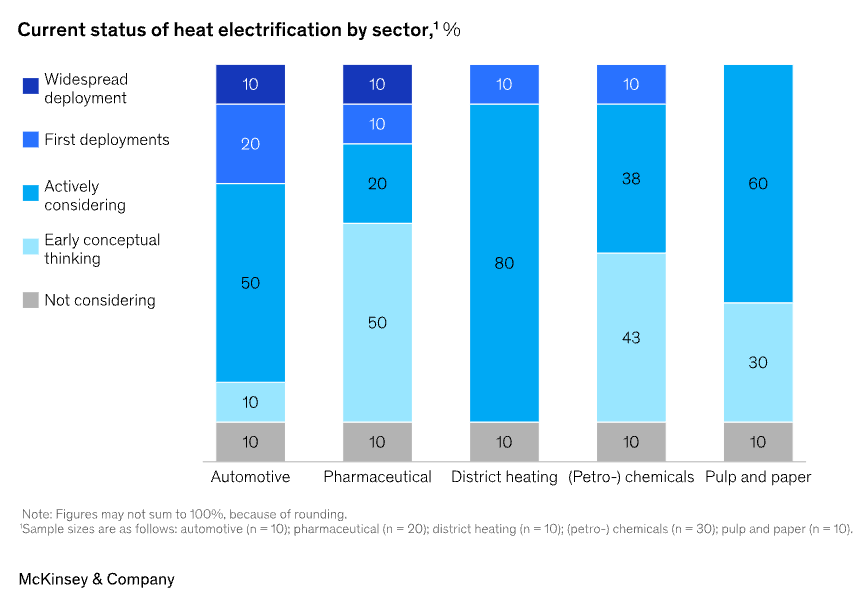
McKinsey published a companion piece on industrial heat electrification in Europe that makes the case that the economics of thermal energy storage as an electrified heat solution are improving meaningfully, with projected returns in most European markets approaching or exceeding typical industrial hurdle rates by 2030. Find it here .

Looking Ahead
The through-line across these three sources is that the technical ceiling is not in dispute, and the barriers to industrial electrification are consistently the same: electricity price distortions, grid connection timelines, equipment constraints, skills gaps, and the investment risk profile of long-lived industrial assets. The energy security argument, the competitiveness argument, and the decarbonization argument are all pointing in the same direction.
That's a wrap for this edition of Industry Signals. Have a report, use case, or event you'd like to see featured in an upcoming issue? Send a note via PM. We're always looking to spotlight what's shaping the future of industry, and recommendations from the Xcelerator Community are especially valuable. Your insights and experiences continually shape Industry Signals.
Comments (0)
Popular

Dive in
Related
Blog
Industry Signals - July 8, 2025: Industrial Electrification: Implications, Risks, and Strategies for Manufacturing’s Sustainable Future
By Industry Signals • Jul 8th, 2025 • Views 726
Blog
Industry Signals - July 8, 2025: Industrial Electrification: Implications, Risks, and Strategies for Manufacturing’s Sustainable Future
By Industry Signals • Jul 8th, 2025 • Views 726