

Enhancing Accessibility in Manufacturing: Key Strategies to Improve Experiences for Disabled and Older Employees

# Digital Transformation
# Digital Manufacturing
# Factory of the Future
# Standardization
# Thought Leadership
Building inclusive manufacturing environments through design, technology, and culture.
December 4, 2025
Antonio Vieira Santos
Improving accessibility in the manufacturing sector for disabled and older employees requires a comprehensive, multifaceted approach. Best practices include implementing inclusive design, leveraging assistive technologies, fostering leadership support, and cultivating a positive workplace culture. Together, these strategies create better experiences and outcomes for disabled workers—while driving overall organizational success.
Barriers and Challenges
- Physical Inaccessibility: Many manufacturing environments lack accessible workstations, equipment, and facilities, which limits the participation of disabled and older employees.
- Attitudinal Prejudices: Negative perceptions and stigma from employers and coworkers can hinder inclusion and discourage employees from requesting accommodations.
- Policy and Knowledge Gaps: Insufficient or poorly implemented policies, combined with limited HR familiarity with assistive technologies, impede effective inclusion efforts.
Effective Strategies and Technologies
- Inclusive Design & Universal Design: Adapting workstations and facilities using universal design principles ensures accessibility for all employees, rather than treating accommodations as exceptions or one-off solutions.
- Assistive Technologies: Tools such as ergonomic equipment, collaborative robots, AR/VR systems, and AI-driven bots enhance physical, cognitive, and sensory capabilities—improving job performance and employee satisfaction.
- Empathetic and Participatory Design: Involving disabled employees in the design and planning of work environments leads to practical, well-accepted, and employee-centred solutions.
- Leadership and Team Culture: Transformational and inclusive leadership, coupled with a supportive team culture, helps reduce stigma, increases self-efficacy, and enables disabled employees to thrive.
- Training and Awareness: Educating HR professionals and staff about disabilities, accommodations, and assistive technologies is essential for successful implementation and ongoing inclusion.
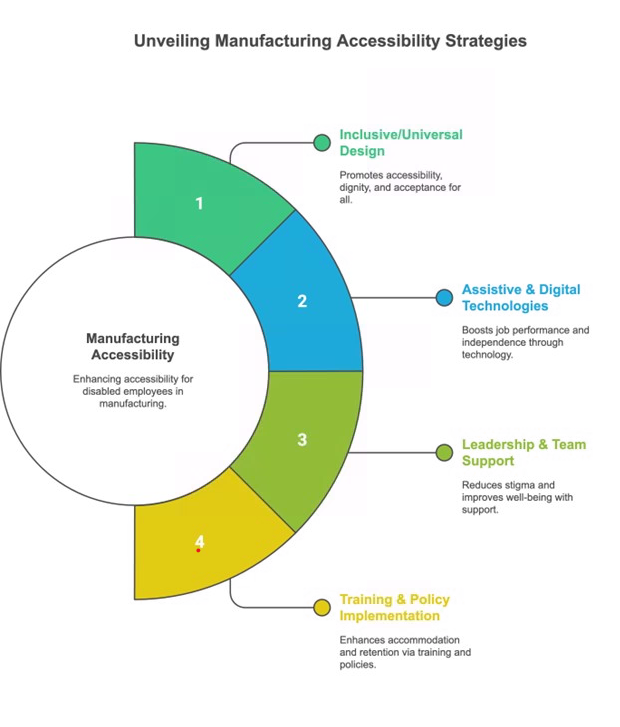
Enhancing accessibility in manufacturing for disabled employees is most effective when organizations combine inclusive design, assistive technologies, supportive leadership, and positive workplace culture. These strategies not only improve workplace experiences for disabled and older employees but also foster innovation, productivity, and overall business success.
If accessibility is a priority for your organisation, we can support you in implementing these strategies. Reach out to learn how our team can help you build a more inclusive and accessible manufacturing environment.
Comments (0)
Popular

Popular
Dive in
Related
Blog
The Good Future of AI is Human Augmentation, Not Replacement: An Interview with Futurist Gerd Leonhard
Dec 16th, 2025 • Views 4
Blog
Join Us For Our Inaugural State of Community Town Hall
By Industry Signals • Dec 2nd, 2025 • Views 31
Blog
The Good Future of AI is Human Augmentation, Not Replacement: An Interview with Futurist Gerd Leonhard
Dec 16th, 2025 • Views 4
Blog
Join Us For Our Inaugural State of Community Town Hall
By Industry Signals • Dec 2nd, 2025 • Views 31